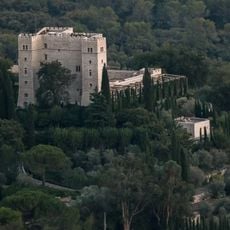
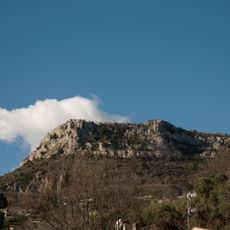
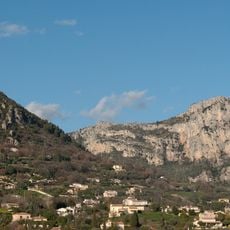
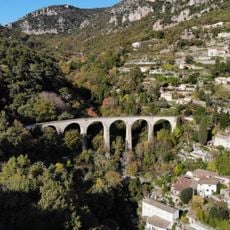
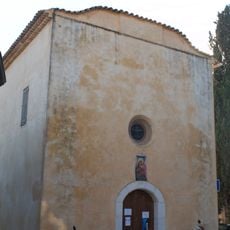
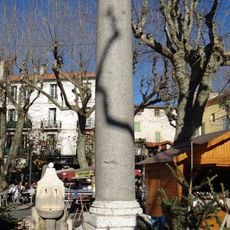
Baou de Saint-Jeannet, Limestone summit in Saint-Jeannet, France.
The Baou de Saint-Jeannet is a limestone mountain in the Préalpes de Grasse, on the territory of Saint-Jeannet in the Alpes-Maritimes, reaching 802 metres. Its plateau tops cliffs that rise more than 300 metres above the village, with pale grey and cream rock cut by vertical gullies and dark streaks. The upper face is bare stone; dark green vegetation covers the lower slopes.
The mountain has been occupied by humans since the Palaeolithic, and the site later drew painters from the 18th century onward. Its Jurassic limestone rests on younger Miocene sediments, a layering produced by an Alpine tectonic overthrust. The cliffs form the eastern end of a karstic plateau on the right bank of the Var, with the Cagne flowing at the foot.
The Provençal word baou, meaning a steep rock with a flat top, gives the mountain its name and recurs in other peaks of southern France. Since the 18th century the cliffs have drawn painters, and the site has been occupied since the Palaeolithic. The summit plateau is grazing land, while the cliff line separates it from the densely settled coast.
Walking routes to the summit start from the village and are clearly marked with regular signs along the way. Sturdy footwear is advisable as the terrain becomes rocky and steep in sections near the top.
The baou's south-facing cliffs host the Nivéole de Nice (Acis nicaeensis), a plant found only in the Alpes-Maritimes, which grows in the open garrigue and grassland. At the entrance of the Grotte Saint-Michel at the foot of the cliff, the fragrant stonecrop Rhodiola rosea marks the southern limit of its range.
The community of curious travelers
AroundUs brings together thousands of curated places, local tips, and hidden gems, enriched daily by 93,520 contributors worldwide.