Perpignan Cathedral, Gothic cathedral in Perpignan, France
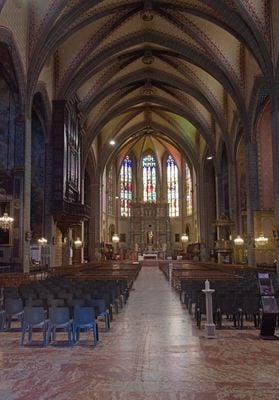
Perpignan Cathedral, or Saint-Jean-Baptiste, is a southern Gothic building of Baixas stone coated in grey, with a single nave 80 m long, 18 m wide and 26 m high, divided into seven quadripartite bays. Its rib vaults spring from corbels rather than rising from the pillars, and beige plaster covers the vault compartments and the walls of the central apse. The west facade was never finished; its Gothic window was rebuilt in the 19th–20th centuries, and the portico and clock tower date from the 18th century.
King Sancho of Majorca launched the new building in 1324, while Perpignan was the capital of his kingdom; the south apse was funded by his sister Sancia of Majorca. The end of the kingdom in 1344 and the Black Death halted work for over sixty years. Under Galceran Albert the plan was cut to a single nave in 1436, the sanctuary was vaulted in 1490–1493, and the church was consecrated on 16 May 1509, 185 years after the first stone. It became a cathedral in 1602 when the bishop's seat moved from Elne.
The cathedral is dedicated to Saint John the Baptist and was granted the status of minor basilica in 1875. In the north transept chapel, look for the painted wooden retable of Saint Peter, moved here from the older Saint-Jean-le-Vieux church. The canons' chapel holds the retable of Saints Julie and Eulalie, carved by Jean-Jacques Melair between 1675 and 1677 and gilded in 1682.
The west facade was never finished: the Gothic window was rebuilt in the 19th–20th-century restoration after a plain rectangular opening had replaced it, and the portico and clock tower date from the 18th century. Inside, the nave is 80 m long, 18 m wide and 26 m high, with 18 chapels; the Baixas stone is rendered grey, while the vault compartments and central apse walls are beige. Look for the painted wooden Saint Peter retable in the north transept apse, moved here from Saint-Jean-le-Vieux.
The adjacent Campo Santo cemetery is the largest medieval burial ground in France, with preserved grave markers and restored niche tombs still visible today. This graveyard demonstrates how burials took place here over many centuries.
The community of curious travelers
AroundUs brings together thousands of curated places, local tips, and hidden gems, enriched daily by 94,483 contributors worldwide.