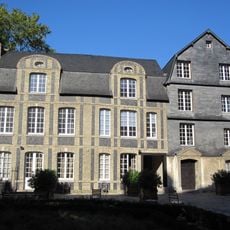
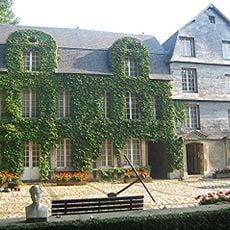
Chapelle Saint-Michel d'Ingouville, Gothic chapel in Le Havre, France
The Chapelle Saint-Michel d'Ingouville is a chapel in Le Havre featuring black flint walls, massive buttresses, and pointed arch windows that are characteristic of 15th-century religious architecture. The interior space is shaped by these Gothic elements and conveys the medieval construction approach.
A Romanesque place of worship existed at Ingouville by the 11th century, first mentioned in 1248. Jean Mallet de Graville had a Flamboyant Gothic church built from 1480, finished in 1516, a year before Le Havre's founding act. It then served as Le Havre's mother church until the Revolution, with Saint-François and Notre-Dame dependent on it. Pillaged by Protestants on 8 May 1562, it lost parish status in 1838 and was renamed Notre-Dame de Bonsecours.
Locals still call the former church "Saint-Michel" although it was renamed Notre-Dame de Bonsecours in 1838. In the public garden in front stands a bust of Father Cochet. Inside, the north wall holds the retable of the old high altar, moved from the apse.
The chapel stands in a public garden north of Le Havre's centre, with a bust of Father Cochet in front of it. The building and its surroundings are protected as a listed site under decrees of 1943. Access is via the garden; the interior is small, essentially a single nave.
Under the tower, a small pointed vault shelters three bells tuned to do, ré and fa; only the largest is electrified, while the other two are still rung by hand ropes. The bell tower rises from the west facade, which old photographs show once had an oculus.
The community of curious travelers
AroundUs brings together thousands of curated places, local tips, and hidden gems, enriched daily by 94,232 contributors worldwide.