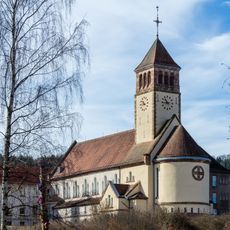
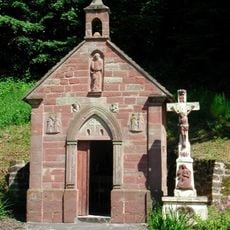
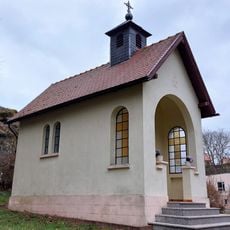
Couvent des Capucins de Bitche, Capuchin convent in Bitche, France
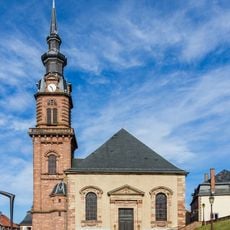
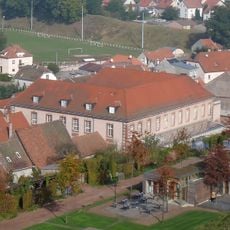
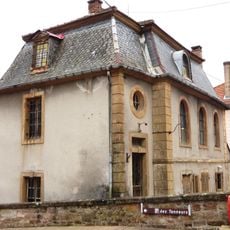
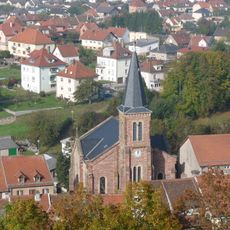
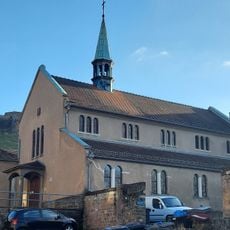
The Couvent des Capucins de Bitche is a large convent building with smooth tan-ochre walls. Its front gable faces left, with a projecting entrance porch holding a dark wooden double door; three tall arched windows with dark frames sit above the porch, and a slender green copper spire topped by a cross rises from the roof ridge behind the facade. The long side wall has two rows of arched windows, an upper row beneath a metal railing and a lower row near a stone foundation, with grey downpipes running down the walls.
Charles IV, Duke of Lorraine, signed the foundation of a Capuchin convent in 1629 and entrusted Pierre Dithmar with the task; the first five friars arrived at the end of that year. In September 1633 the Swedish army invaded Lorraine and burned Rohr and Kaltenhausen, driving the friars from their unfinished buildings. The Capuchins returned in 1690 and built a small convent on the present site, but by 1722 only two fathers remained and they handed it to Duke Leopold I. Augustinian fathers took over in 1724; in 1727 Jean Will laid the first stone of a chapel, and in 1731 he and Emilien Keller opened a monastic school.
The convent became an educational hub when Augustinian monks opened a school here in the 1700s to serve local children. This teaching role shaped how the community viewed the building and its monks for generations.
The convent stands on a trapezoidal plot between rue Saint-Augustin, rue de l'Abattoir and rue des Capucins, a short walk from the centre of Bitche. The entrance porch with its dark wooden double door faces the street; the long side wall has two rows of arched windows above a stone foundation. Look up for the slender green copper spire topped by a cross.
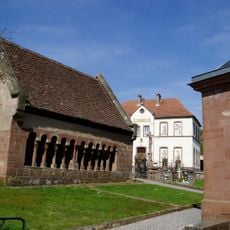
The convent was never finished as first planned: the Capuchins' early buildings were left incomplete when the Swedish army burned Rohr and Kaltenhausen in September 1633, and the monks fled. The community returned only in 1690, when the Champagne province sent friars to serve the troops at Vauban's new citadel, and they dug a well on the site of the present Lavoir.
The community of curious travelers
AroundUs brings together thousands of curated places, local tips, and hidden gems, enriched daily by 93,091 contributors worldwide.