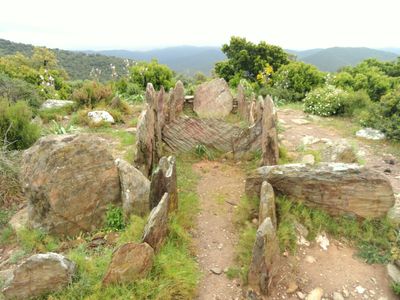
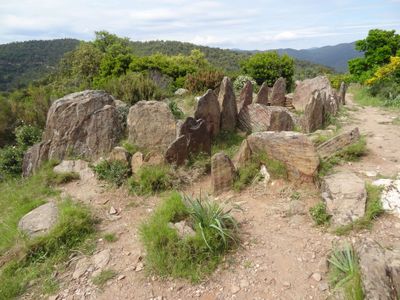
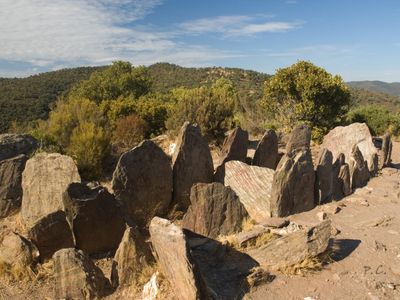
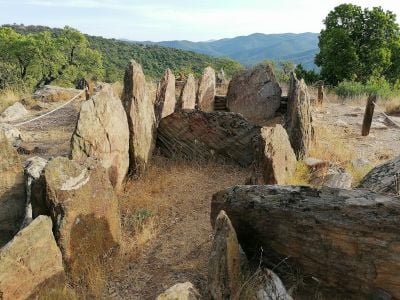
Gaoutabry dolmen, Neolithic tomb in La Londe-les-Maures, France
The Gaoutabry dolmen stands as the largest monument of its kind in Var department, measuring approximately ten meters long and built from local schist slabs arranged to form a burial chamber and antechamber.
Discovered in 1876 by Baron Gustave Charles Ferdinand de Bonstetten, this monument was initially thought to be three separate structures before being confirmed as a single construction dating from 2800 to 2000 BC.
The name comes from Provençal: gaouto, the slope of a hill, and abry, a sheltered spot, describing a refuge on a hillside. The monument is built entirely of schist slabs taken from a nearby outcrop, and the passage from the entrance corridor to the antechamber is framed by three orthostats set obliquely like a funnel, a layout exceptional in Provence.
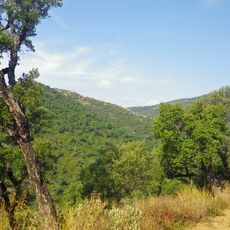
Located at 198 meters altitude in the Massif des Maures, the site is accessible via a marked blue trail from Notre Dame des Maures parking area, closed between June 21 and September 20 due to fire prevention measures.
The vertical stone slabs separating the chamber from the antechamber display notches suggesting they may have supported a wooden or stone roof, a construction technique rarely documented in Provençal dolmens.
The community of curious travelers
AroundUs brings together thousands of curated places, local tips, and hidden gems, enriched daily by 92,652 contributors worldwide.