Fort National, Military fort on tidal island near Saint-Malo, France.
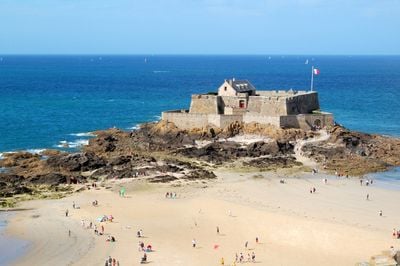
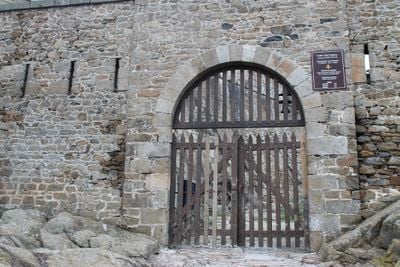
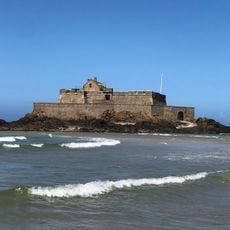
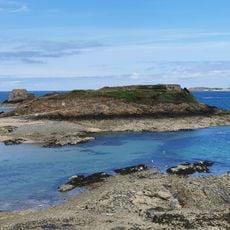
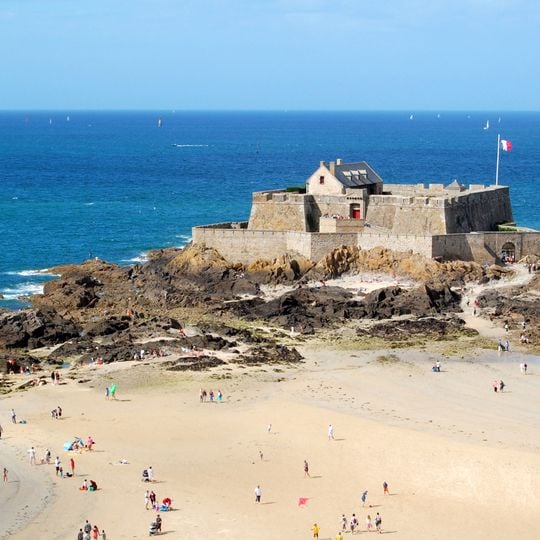
Fort National is a granite fort on the Îlette rock, a tidal island a few hundred metres off Saint-Malo. Its original rectangle has two half bastions at the south protecting the gate, reached by a drawbridge across a dry moat. Inside stands a long building with officers' and troops' quarters and equipment rooms; an 1848 wall pierced for small arms encircles about three-quarters of the fort, with a small bastion before the gate.
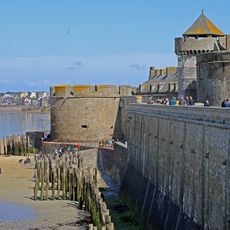
Vauban drew the plans and Siméon Garangeau built the fort on the Îlette rock from 1689 to 1693, on Louis XIV's orders, as an advance bastion of Saint-Malo's defences. In November 1693 an Anglo-Dutch fleet attacked the region; the fort was then armed with 14 guns and three mortars. In 1848 engineers added a wall pierced for small arms around three-quarters of the fort and a small bastion before the gate.
The fort's changing names gave it the nickname Fort Caméléon: Fort Royal, then Fort d'Îlette or Républicain in 1789, Fort Impérial, and Fort National after 1870. A commemorative plaque inside honours the 18 prisoners killed by Allied shellfire on the night of 9 to 10 August 1944.
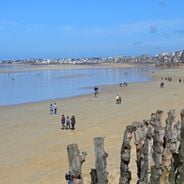
Access is only possible at low tide, from 1 June to 30 September and on certain other days; the fort can be visited when the French flag is flying. The walk crosses the sandbank from the walled city of Saint-Malo, so check tide times before setting out.
This fortification went through several name changes over the centuries: Fort Royal, Fort d'Îlette, Fort Républicain, Fort Impérial, and finally Fort National after 1870. Each name shift reflected France's changing political circumstances.
The community of curious travelers
AroundUs brings together thousands of curated places, local tips, and hidden gems, enriched daily by 94,763 contributors worldwide.