Fort d'Hauteville, Military fort in Hauteville-lès-Dijon, France.
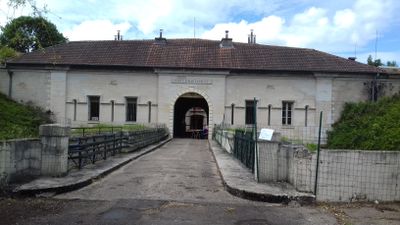
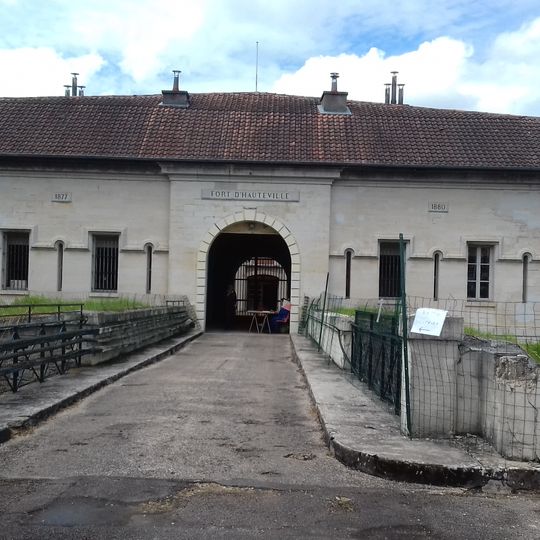
Fort d'Hauteville is a long, single-storey stone building with a pale off-white facade and a steeply pitched roof of reddish-brown tiles, topped by three small chimney stacks and a thin central mast. A large round-headed archway framed by stone voussoirs and closed by an inner metal gate forms the entrance; above it a rectangular plaque reads "FORT D'HAUTEVILLE", and the dates 1877 and 1880 are carved above the windows to either side.
The fort was built between 1877 and 1880 as part of the Séré de Rivières defensive system, a network designed to protect France after its defeat in the Franco-Prussian War. It represents the country's effort to reinforce its eastern border with modern fortifications.
The fort's name recalls Hauteville-lès-Dijon, the hilltop commune above Dijon where it stands; for a few years under Minister Boulanger it was renamed fort Carnot. Since 2025 it has housed the musée Choillot. The 1877 and 1880 dates carved above the windows flanking the entrance arch record its construction.
The fort stands on the heights of Hauteville-lès-Dijon, above the city of Dijon. It was bought by the commune from the Ministry of Defence by a municipal council decision of 31 August 2010, and since 2025 it houses the Musée Choillot. The entrance arch on the facade bears the inscription "FORT D'HAUTEVILLE", with the dates 1877 and 1880 carved above the windows on either side.
The fort was briefly renamed fort Carnot in 1887 during the Boulanger ministry, a detail easily missed on site. In 1942 it served as an annex of the Dijon prison, where Jews, resistance fighters and common-law prisoners were held before transfer to Drancy; registers record 3,821 detainees. Since 2025 it houses the musée Choillot.
The community of curious travelers
AroundUs brings together thousands of curated places, local tips, and hidden gems, enriched daily by 93,132 contributors worldwide.