Gorges de Kakouetta, Canyon system in Sainte-Engrâce, France.
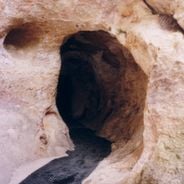
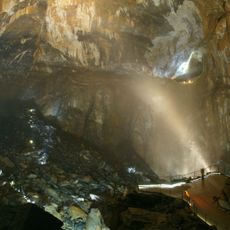
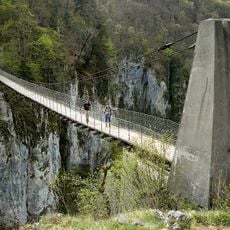
Gorges de Kakouetta is a canyon system in the Pyrenees that winds through limestone formations with walls reaching about 350 meters high. A river flows along the floor and creates a natural corridor accompanied by wooden pathways that guide visitors through the system.
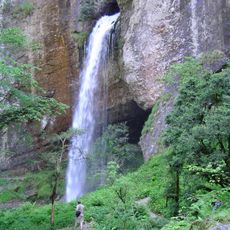
Édouard-Alfred Martel led the first exploration of the gorges in 1906. The stream, the Kakueta, rises at the Urdaite or Arrakogoiti pass on the border with Navarre, near Isaba, and cuts through limestone between the Lakora, Larregorri and Eskantolha mountains. In October 1937 heavy rain left the Kakueta waterfall flowing above its normal level for nine months, a volume far larger than its known catchment could explain.
The gorge lies in the Basque province of Haute-Soule, and its name is rendered Kakueta in Basque and Spanish. The stream that carved it, the Uhaitza, is fed by tributaries such as the Achourako erreka and the Sombiague, and by underground flows from the Larra karst system, including the San Jorge and San Martín rivers.
The visit is only possible at low water, generally from 1 July to the end of September. About 1.5 km of the roughly 4 km gorge is laid out with rock steps and footbridges. The site has been closed to visitors since a fatal accident in August 2020, so check its status before travelling.
The Kakueta waterfall's flow puzzled hydrologists: in October 1937 heavy rain kept it discharging over one cubic metre per second above its normal level for nine months, implying a reserve of more than 25 million cubic metres, while the visible catchment could account for only about 2.5 million. Its underground source, fed by the Larra karst system, remains unmeasured.
The community of curious travelers
AroundUs brings together thousands of curated places, local tips, and hidden gems, enriched daily by 93,784 contributors worldwide.