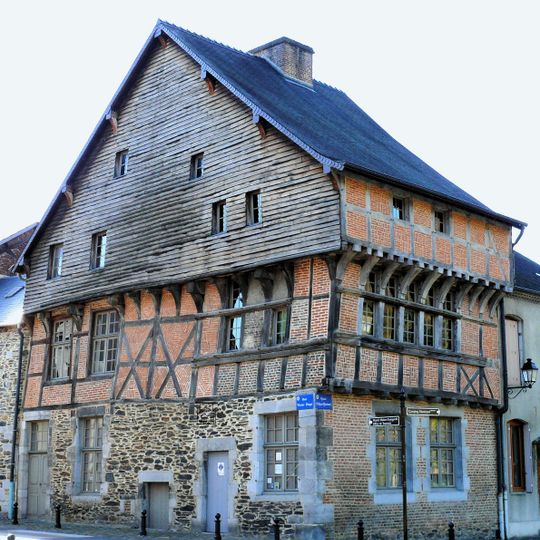
Maison espagnole de Revin, Historic timber house in Revin, France.
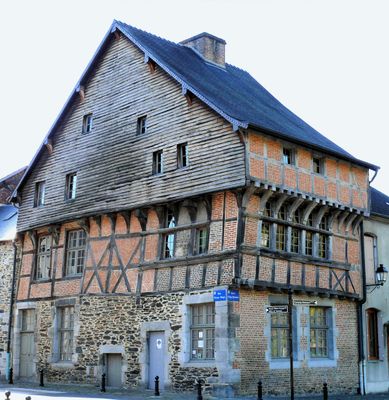
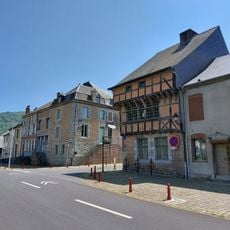
The Maison espagnole de Revin is a two-storey house with a rough grey stone ground floor and a jettied upper storey of red brick panels and dark timber framing. Its gable is clad in horizontal weatherboards, and a massive brick chimney rises at the ridge of the steep slate roof. The entrance is at 2, rue Victor-Hugo, near the quays along the Meuse.
Built in the first half of the 16th century, the house is thought to be the last surviving trace of the Spanish period in Revin, which lasted until 1769, hence its name. Dendrochronology dates the oak roof frame to trees felled between 1510 and 1515. It withstood the reshaping of the quays, bridge construction, floods and the tornado of 14 July 2010, was listed as a monument historique in 1990 and restored in the 1990s.
The name is only a popular tradition: the house is said to be the last remnant of the Spanish period in Revin, which ended in 1769. Since the 1990s it has housed the Musée du Vieux Revin. The ground floor reconstructs the daily life of a modest Revin family in the 1920s-1930s, while the second floor shows the foundry trade, with moulders' tools and products of local firms such as Arthur Martin.
The building sits in central Revin along the Meuse and is easily reached on foot from most parts of the town. Visiting works well for a short stop, and guided tours are offered regularly during warmer months.
Scientific analysis of the wood structure shows that oak beams came from trees felled around 1510. This precise evidence makes the house an important example of how tree-ring dating can verify age and construction dates with accuracy.
The community of curious travelers
AroundUs brings together thousands of curated places, local tips, and hidden gems, enriched daily by 93,178 contributors worldwide.