Menhir de Peyrefitte, Neolithic menhir in Saint-Sulpice-de-Faleyrens, France
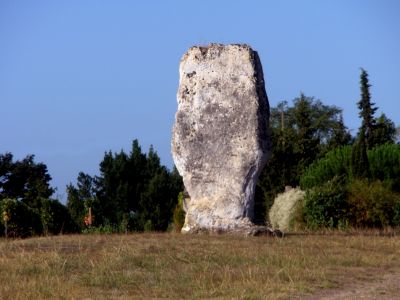
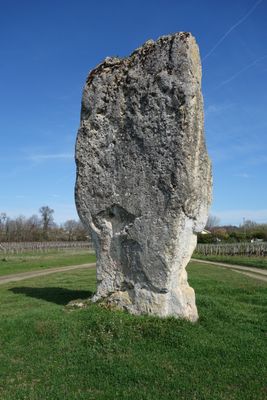
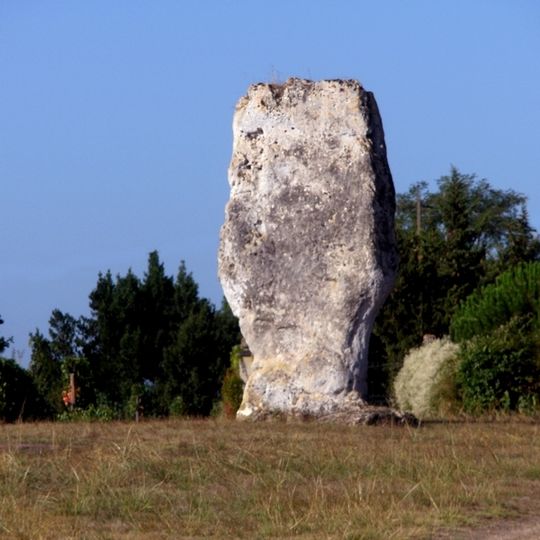
The Menhir de Peyrefitte is a single upright block of limestone with a quadrangular cross-section, standing in a field of dry grass near Saint-Sulpice-de-Faleyrens. It measures about 5.2 m high, 3 m wide and 1.5 m thick, and is estimated to weigh 50 tonnes including its buried base. The pale grey stone is deeply pitted and mottled with dark patches, narrows at its lower part, and shows no carvings on its broad face.
The stone was erected during the late Stone Age, long before Roman times reached this region. In medieval times it was mentioned in local documents and has remained standing in the landscape ever since.
The name Petra-fixa, recorded in 1289 and 1290, survives in the local forms Pierrefitte and Pierre Fitte. On 24 June, the feast of Saint John, the stone is decorated and a candlelit procession circles it twice, each walker making a wish before entrusting the candle to the Dordogne; some float their written wish on a folded paper boat.
The stone stands in open countryside and is visible from nearby roads. Visitors should wear sturdy shoes since the area is hilly and can become muddy after rain.
On one face, 0.70 m above the present ground level, a circular "offering hole" was hollowed out in the Middle Ages. The photograph's broad face shows no such carving, so the hole must be sought on another side of the block.
The community of curious travelers
AroundUs brings together thousands of curated places, local tips, and hidden gems, enriched daily by 93,730 contributors worldwide.