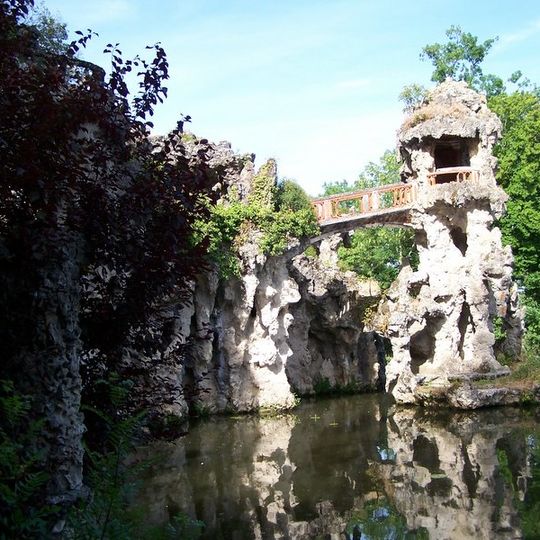
Parc de Majolan, Historic park in Blanquefort, France.
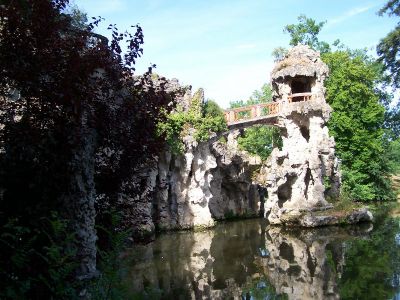
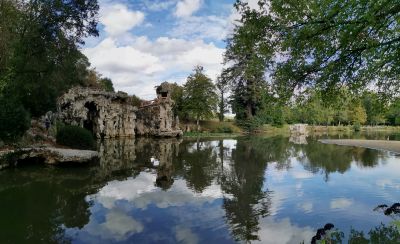
Parc de Majolan spans 20 hectares featuring artificial caves, ornamental bridges, fountains, geysers, and a central lake formed by diverting the Jalle de Blanquefort river through ingenious 19th-century hydraulic engineering techniques.
Created between 1870 and 1880 by landscape architect Louis Le Breton for wealthy banker Jean Gustave Piganeau, the park was built on former marshland and transformed into an elaborate romantic garden reflecting baroque aesthetic principles of the era.
The park's name comes from the Dulamon estate, whose wine property Joseph Prom bought in 1862; his son-in-law Gustave Piganeau then had the marsh turned into a lake and rockwork. Visitors cross bridges each built differently: with lianas, in Gothic style, in faux bois (ornamented concrete) and in wrought iron. The grotto's central room once had walls of aquariums, a nod to the 1867 Paris World's Fair; the tanks remain but the glass is gone.
The park lies on the western edge of Blanquefort, around a 4-hectare lake fed by the Jalle. Paths are wide-meshed and stop abruptly to the north, where housing begins; the grotto stands on the lake's north shore, reached by boat from the water or by two entrances hidden in the rock, one through a rocaille garden, the other via a small valley.
The park's artificial caves constructed with lime feature facades simulating ancient ruins with sophisticated hydraulic systems that create water jets both inside and outside the structures, bringing dynamic movement to the artificial landscape.
The community of curious travelers
AroundUs brings together thousands of curated places, local tips, and hidden gems, enriched daily by 92,822 contributors worldwide.