Place Garibaldi, Central square in Nice, France
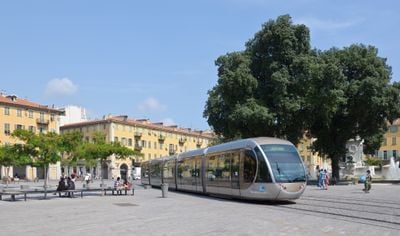
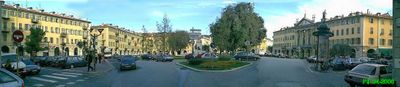
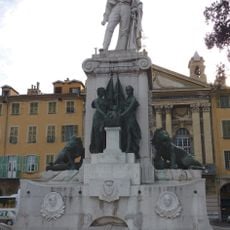
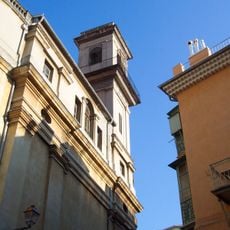
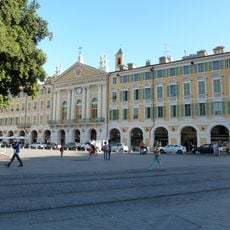
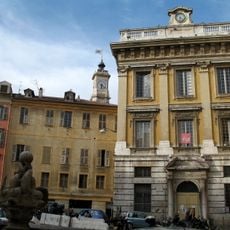
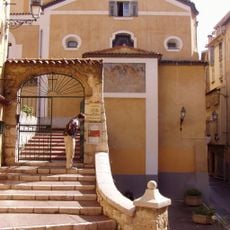
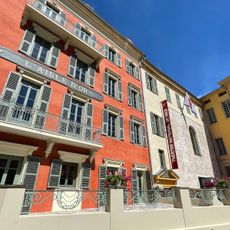
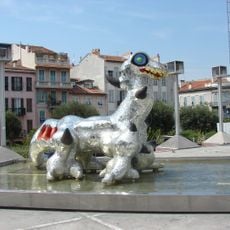
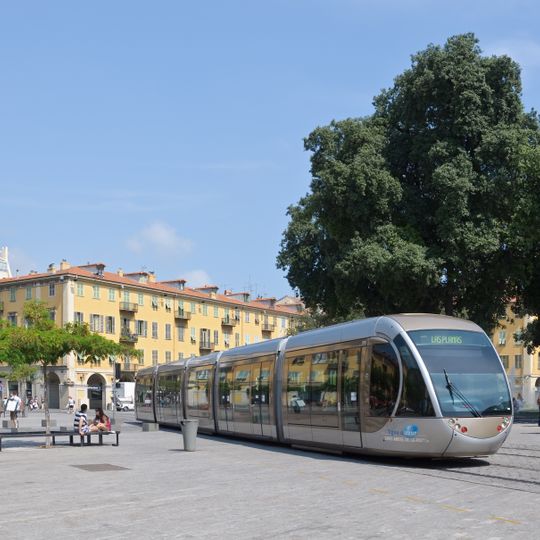
The square displays yellow facades with green shutters, arcade passages and a central statue surrounded by symmetrically arranged buildings and a fountain. The rectangular layout is bordered by uniform multi-story structures featuring enclosed arcades on the ground floor. Paving and green spaces divide the public area into different zones for pedestrians.
Construction began in 1773 on the plans of architect Antoine Spinelli, on the site of a wasteland left by the dismantling of the castle walls; the first project had been adopted in 1761 but lacked funding. In 1780 King Victor Amadeus III made the Turin road carriageable and the square was enlarged as the royal route's terminus. It was renamed Place Garibaldi on 13 September 1870 on the proposal of prefect Baragnon, after passing through the names Pairoliera, Victor-Emmanuel, place d'Armes and Saint-Augustin.
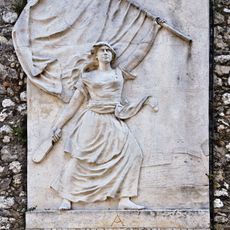
The square honors Giuseppe Garibaldi, born in Nice in 1807 before he assumed a leading role in the Italian unification movement. His central monument recalls the historical connections between Nice and Italy as well as the political transformations of the 19th century. The square serves as a gathering place for local events and public assemblies.
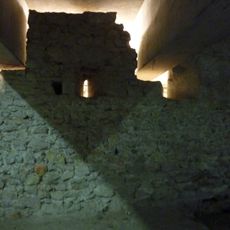
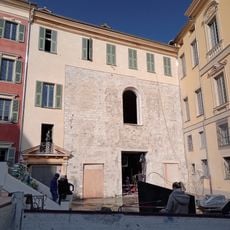
The square is semi-pedestrian: a two-way paved axis crosses it from Rue Cassini to Rue du Docteur Ciaudo, with other lanes along the south and southeast sides. Tram line 1 of the Nice network runs north-south across the square and stops at Garibaldi, crossing without overhead wires. The monument and its square basin were moved 18 metres south in November 2007 for the tram works. A visitable crypt beneath the southwest side holds remains of the Pairolière tower, the Saint-Sébastien bastion and the Augustins suburb.
The building facades employ trompe-l'oeil painting techniques that simulate architectural elements rather than using actual stone decorations. This illusionistic approach was a cost-effective method to give the square a uniform aristocratic appearance. The painted details include window frames, cornices and ornaments that appear as three-dimensional stonework from a distance.
The community of curious travelers
AroundUs brings together thousands of curated places, local tips, and hidden gems, enriched daily by 94,135 contributors worldwide.