Puy de la Bannière, Extinct volcano in Volvic, France
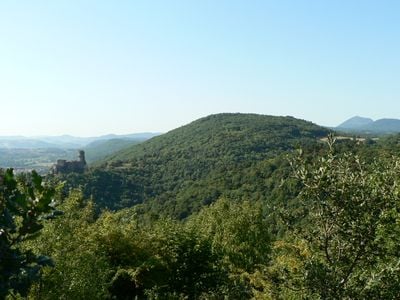
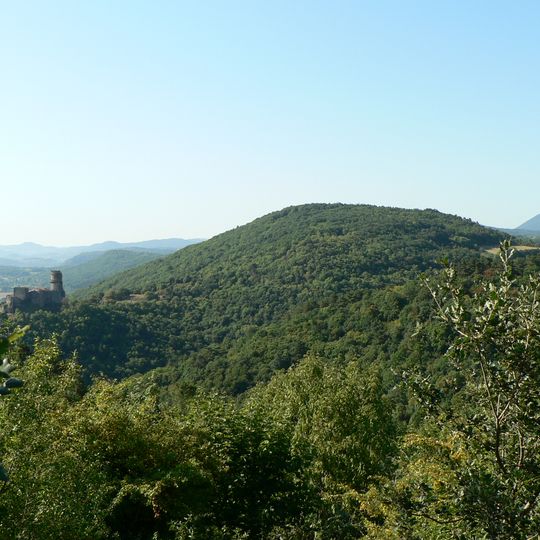
Puy de la Bannière is an extinct scoria cone of trachyandesitic composition rising to 733 metres on the Volvic commune. Its eroded, densely wooded slopes descend evenly on all sides, and it lies just west of the Limagne fault, about 6 km from the main Chaîne des Puys ridge. It emitted no lava flows during its activity.
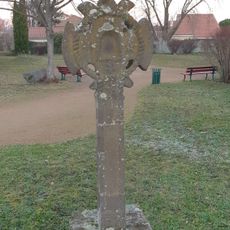
In 1751, Jean-Étienne Guettard and Malesherbes climbed the Puy de la Bannière and established its volcanic origin from the cone shape, the scoriae and the central funnel-shaped crater. In 1861 the École d'architecture de Volvic laid out a Way of the Cross linking the town centre to the southern flank, where the Notre-Dame-de-la-Garde statue stands.
The Virgin statue Notre-Dame-de-la-Garde stands on the volcanic slopes, built from local stone and visible from the town below. This monument shows how the volcano has shaped the identity and landmarks of the surrounding area.
The Way of the Cross laid out in 1861 by the Volvic architecture school links the town centre to the southern flank, where the Notre-Dame-de-la-Garde statue stands. The summit reaches 733 m above Volvic, whose centre sits at 494 m. The wooded côte Verse valley below, crossed by the Barret and Sauzet streams, is a protected natural area since 2009.
From the summit, the flat Limagne plain stretches into the distance with several towns visible across the horizon. This sweeping view shows how the volcano stands out above the surrounding landscape.
The community of curious travelers
AroundUs brings together thousands of curated places, local tips, and hidden gems, enriched daily by 92,890 contributors worldwide.