Carnot bridge, Arch road bridge between Collonges and Chevrier, France
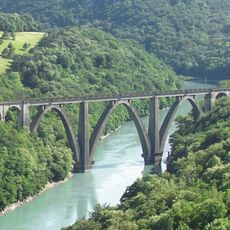
The Carnot Bridge is an arch structure made of masonry that crosses the Rhône River between Collonges and Chevrier. It carries road traffic across the river and forms a key connection between two communes in different French departments.
After Savoie joined France in 1860, riverside communes obtained a declaration of public utility on 31 August 1860. Work began in 1865 under Sadi Carnot, engineer of Ponts et Chaussées in Haute-Savoie, was halted by the Franco-Prussian War of 1870, and finished in 1874; the bridge opened the next year and won a prize at the 1878 Universal Exhibition.
The bridge was first called pont de Collonges, or pont du Rhône in administrative papers, and was renamed pont Carnot once its designer, the engineer Sadi Carnot, became President of the Republic. He had directed the works as a Ponts et Chaussées engineer in Haute-Savoie.
The bridge carries traffic on Route Départementale 1206 and is accessible at all times. Crossing takes just a few minutes and poses no particular challenges.
The original masonry construction has remained essentially unchanged since it was built and demonstrates how long such arch bridges can last. Despite modern building techniques making this method obsolete, it stands as evidence of 19th-century craftsmanship.
The community of curious travelers
AroundUs brings together thousands of curated places, local tips, and hidden gems, enriched daily by 94,372 contributors worldwide.