Viaduc de Longeray, Railway bridge in Léaz and Clarafond-Arcine, France
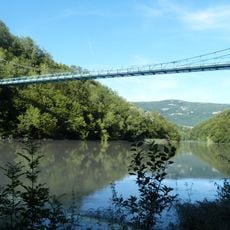
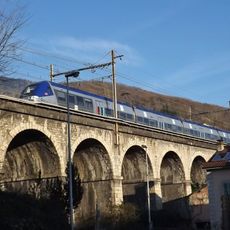
The Viaduc de Longeray is a reinforced concrete railway bridge over the Rhône at the exit of Longeray-Léaz station. Its flat deck carries tracks and overhead line equipment on slender piers that taper upward, with parabolic arches between them; the three central spans repeat the 48, 58 and 69 m spans of the 1880 iron bridge. The deck joins an older masonry viaduct of five 15 m round arches on the eastern slope, and a concrete viaduct with three 15 m arches replaced the western approach.
A first viaduct, known as the Viaduc du Credo, was built here in 1875-1880 to designs by engineers Moris and Ruelle for the Joret et Compagnie, with four iron lattice spans on three masonry piers. On 19 June 1940 a French engineer unit blew up one of the two central piers to block the German advance, and the deck collapsed. The SNCF rebuilt the crossing in reinforced concrete from 1941, and trains ran again in 1943.
The bridge is named after the hamlet of Longeray in Léaz, where the line from Bellegarde to Annemasse branches off from the Lyon–Geneva route. It carries the single-track line through the Défilé de l'Écluse, the gorge where the Rhône cuts through the Jura. TER Rhône-Alpes trains between Bellegarde-sur-Valserine and Évian-les-Bains cross it, and at weekends a TGV between Paris Gare de Lyon and Évian-les-Bains passes over it.
The bridge crosses the Rhône in the Défilé de l'Écluse, between Léaz in Ain and Clarafond-Arcine in Haute-Savoie, about 20 km southwest of Geneva. It carries the single-track line from Longeray-Léaz toward Annemasse and Évian-les-Bains, used by TER Rhône-Alpes trains and, at weekends, a TGV between Paris Gare de Lyon and Évian-les-Bains. The structure is seen from outside; the deck itself is not open to pedestrians.
The parabolic arch over the Rhône was cast on timber centring built in two sickle-shaped halves, first erected almost vertically at the pier bases and then lowered toward the arch centre. According to the sources, this method was probably used here for the first time and was much discussed afterwards.
The community of curious travelers
AroundUs brings together thousands of curated places, local tips, and hidden gems, enriched daily by 94,658 contributors worldwide.