Roches gravées de la Carapa, Pre-Columbian rock art site in Kourou, French Guiana
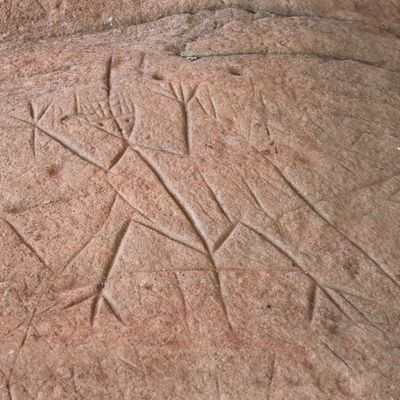
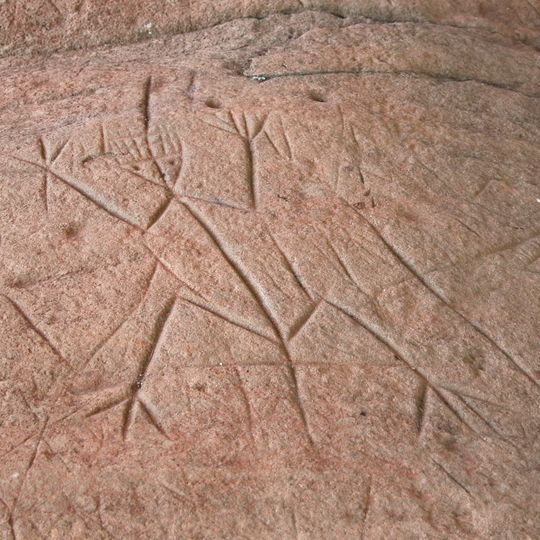
Roches gravées de la Carapa is a rock-art site in Kourou, French Guiana, with more than 150 petroglyphs concentrated on two neighbouring boulders, and a third group nearby. The carvings are cut as narrow, pale furrows into flat slabs of reddish-brown sandstone. One large abstract figure has a central vertical groove crossing a long horizontal line, with shorter diagonal strokes branching at the top and V-shaped lines converging near the base.
The rocks were first noted on a 1904 cadastral plan and appeared sporadically in scientific literature, notably in 1955. They were only recognised and added to the archaeological map in 1992, when the site was thought to have been destroyed. Investigations found more than 150 petroglyphs, mainly on two neighbouring rocks. The site was classified as a historical monument on 18 November 1993.
The rock engravings show human figures with characteristic M and W patterns on their arms and legs, reflecting ancient carving methods used by the people who lived here long ago.
The engravings lie on two neighbouring rocks in Kourou, with a third group possibly nearby; the site was only added to the archaeological map in 1992, so paths and facilities are not described in the sources. Access is on foot over the rock surfaces themselves, and the carved lines are best seen in raking light rather than at midday.
The site was long thought destroyed before being rediscovered and added to the archaeological map in 1992. Investigations then counted more than 150 petroglyphs, mostly on two neighbouring rocks, with a third group nearby. The slab in the photograph shows a large abstract figure of crossing and branching grooves, not a named animal carving.
The community of curious travelers
AroundUs brings together thousands of curated places, local tips, and hidden gems, enriched daily by 93,075 contributors worldwide.