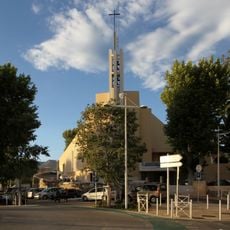
Église Notre-Dame-du-Bon-Voyage de La Seyne-sur-Mer, Baroque Catholic church in La Seyne-sur-Mer, France.
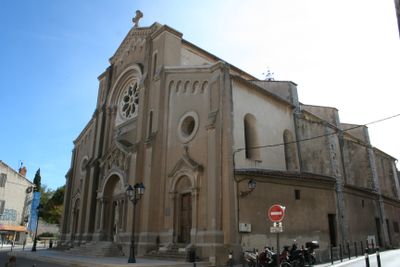
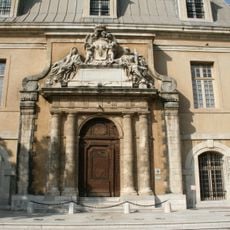
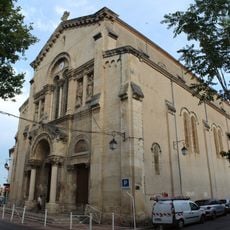
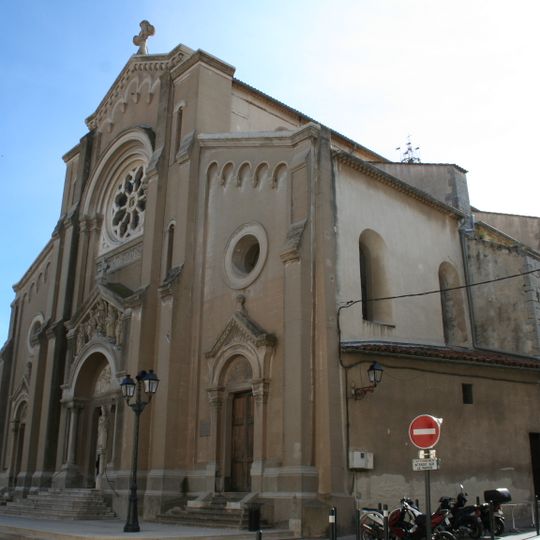
Église Notre-Dame-du-Bon-Voyage is a tan-stone church in La Seyne-sur-Mer whose facade, rebuilt in 1890 by architect Paul Page, has a central sculpted portal, a large rose window and a cross at the peak. The interior has three naves of four rib-vaulted bays, 39 m long and 19 m wide, ending in a square choir under an eight-sided dome with an oval oculus.
A first chapel built in 1603 became insufficient after La Seyne was detached from the parish of Six-Fours in 1657. On 23 May 1673 the town council voted to rebuild on the chapel's razed site; masons Pierre and Jean Delvaux of Aix-en-Provence laid the first stone on 8 June 1674 and finished in 1682. The church was inscribed as a monument historique on 2 December 1988.
The church is dedicated to Notre-Dame du Bon-Voyage, a name tied to the maritime life of La Seyne-sur-Mer. Inside, visitors can see a statue of Notre-Dame de Bon Voyage, a reliquary bust of Saint Eloi and a carved group of Saint Joseph and the Christ Child. The four bells date from 1862 and were cast by Émile Baudouin of Marseille.
The church faces southwest, with the sculpted portal and rose window on the main facade and a second arched wooden door on the lower right section, reached by steps beside a street lamp. It is an active parish church, so visits should avoid Mass times and keep silent during services.
An organ built by François Mader in 1892 stands inside the church and contributes significantly to the musical character of the building. This instrument is less known than the architecture itself, but is valued by those who hear it as a jewel of local religious tradition.
The community of curious travelers
AroundUs brings together thousands of curated places, local tips, and hidden gems, enriched daily by 92,838 contributors worldwide.