Église Saint-Jacques-le-Majeur de Montrouge, Brutalist church in Montrouge, France
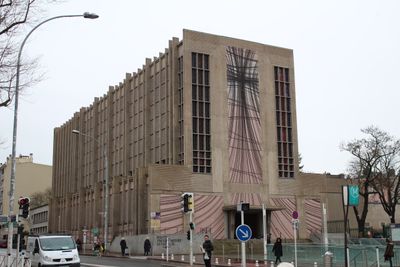
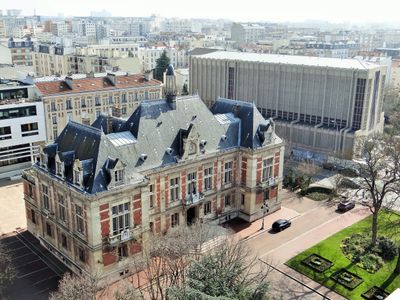
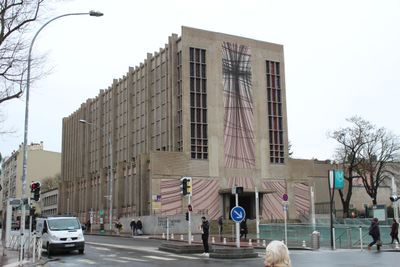
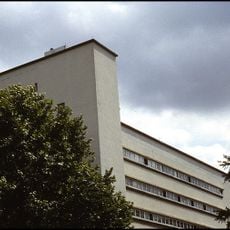
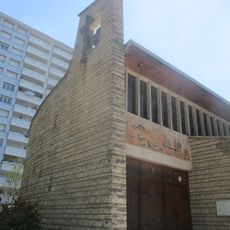
Église Saint-Jacques-le-Majeur is a reinforced-concrete church built 1933–1937 to plans by architect Éric Bagge, using Eugène Freyssinet's articulated-portal frames. The nave measures 57 m long, 13.25 m wide and 20 m high, with a 12.5 m choir. Its flat facade is covered by closely spaced vertical concrete fins, and the planned bell tower was never built.
A parish church existed here since at least the 14th century; it was restored under Francis I in 1533, rebuilt in 1700 and again in 1823-1828 by architect Simon Vallot. That 19th-century building was demolished as too small and to make way for the crossroads of the Grande-Rue and avenue de la République. The present church was built in reinforced concrete by architect Éric Bagge from 1933 to 1937, funded by the Œuvre des Chantiers du Cardinal.
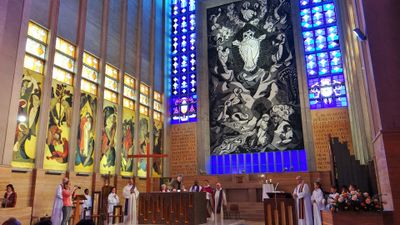
In 1885 the bishop of Paris named this church one of three pilgrimage sites for those unable to reach Compostela. The scallop shell, emblem of Saint James, appears at the centre of the blue and orange windows on the side walls.
The church stands at the junction of Grande Rue (now Rue Gabriel Péri) and Avenue de la République, on the site cleared when the 1823-1828 building was demolished. Enter from the forecourt; the nave runs 57 m long and 20 m high, so the frescoes on the left wall and the grey Transfiguration panel behind the altar are best read from the far end. The bell tower planned by Éric Bagge was never built.
During the 2013–2017 restoration, workers replacing the floor found two 18th-century burials beneath the nave. The concrete foundations had been attacked by sulphate contamination from a former tannery on the site, so they were renewed and the polluted earth exchanged. The new altar was consecrated on 27 November 2016.
The community of curious travelers
AroundUs brings together thousands of curated places, local tips, and hidden gems, enriched daily by 92,849 contributors worldwide.