Église Sainte-Thérèse, Roman Catholic church in Nantes, France
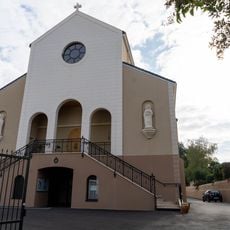
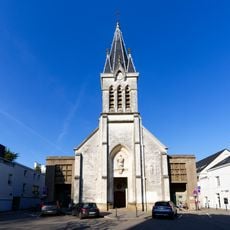
Église Sainte-Thérèse is a Romano-Byzantine church on Place Alexandre-Vincent in Nantes, built of concrete faced with red Beauvais brick and columns of granite from Saint-Macaire-en-Mauges. Its facade has a recessed archway with a double door, a white sign with blue lettering, a row of seven narrow arched windows and a circular medallion with a pale figure. The bell tower stands 23 metres high.
The first stone was laid on 3 October 1935 for a church planned by architects René Ménard and Maurice Ferré at the request of abbé Louis Larose. Foundations were dug on 29 March 1939, but bombing on 16 September 1943 destroyed the rising walls, notably on the south side. Work resumed in 1952, the crypt chapel opened that 4 October, and the church was consecrated in October 1960 by bishops Jean Villepelet and André Jacquemin.
The parish is named after Thérèse de l'Enfant-Jésus, chosen by Eugène Le Fer de La Motte after abbé Louis Larose's pilgrimage to Lisieux; Larose became the first curé. The Christ en gloire by sculptor Jean Fréour was added in 1958 in the chapel beneath the tower, opened for worship on 4 October 1952.
The church stands on the south-west side of Place Alexandre-Vincent in the Breil-Barberie district, in north-west Nantes, not in the city centre. The parish complex, including the school and college, faces it across rue du Chanoine Larose. The main door is set in a wide recessed archway beneath the seven arched windows of the facade.
The campanile was planned at 70 metres but stops at 23. The architects René Ménard and Maurice Ferré also left the pillar capitals undecorated and made the dome octagonal rather than circular, choices specified in their plans for this Romano-Byzantine church of concrete faced with red Beauvais brick.
The community of curious travelers
AroundUs brings together thousands of curated places, local tips, and hidden gems, enriched daily by 94,143 contributors worldwide.