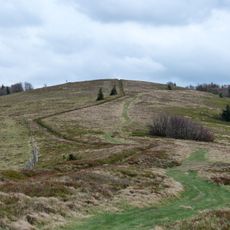
Château de Wildenstein, Medieval fortress in Kruth, France.
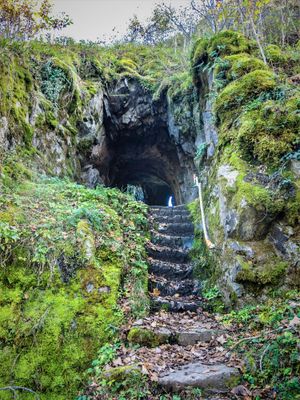
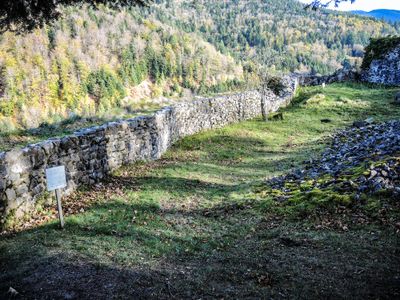
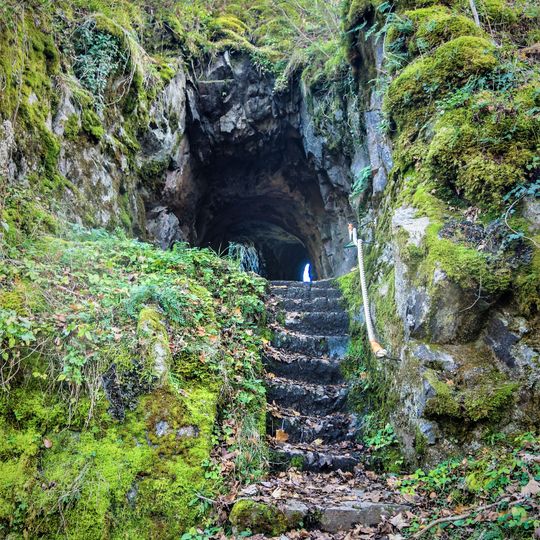
Château de Wildenstein occupies the whole summit of a rocky spur called the Schlossberg, at 666 m altitude in the commune of Kruth. The rock was pierced by a tunnel giving access to the lower courtyard, enlarged in the 16th century. Little remains: traces of round towers, low wall sections, staircases cut into the rock leading to the upper terrace, and a well-preserved retaining wall east of the lower courtyard.
Wildenstein is first documented in 1312, when Count Ulrich III of Ferrette promised the abbot of Murbach not to build castles on abbey land, provided Pierre de Bollwiller had a free hand there; it stayed with Bollwiller's family until 1536. The abbot of Murbach then bought the near-ruined castle, rebuilt it for firearms warfare and added a chapel to the Holy Cross. Swedish troops destroyed it in 1644.
The castle is also called Schlossberg, after the rocky spur it occupies. The chapel built under the abbey of Murbach was dedicated to the Holy Cross; little of it is visible today, and the site's layout is hard to trace on the ground, though a plan by abbé Gilles Sifferlen records the buildings.
The ruins sit on the Schlossberg at 666 m, reached on foot; the rock is pierced by a tunnel giving access to the lower courtyard, enlarged in the 16th century. Staircases cut into the rock lead up to the upper terrace, and the ground is uneven, so wear sturdy shoes. The only well-preserved wall is the retaining wall east of the lower courtyard.
The tunnel does not run beneath the castle: it pierces the rock of the Schlossberg itself to give access to the lower courtyard, which was artificially enlarged in the 16th century. Visitors enter through this jagged arch and climb a stairway cut into the stone toward the upper terrace.
The community of curious travelers
AroundUs brings together thousands of curated places, local tips, and hidden gems, enriched daily by 94,512 contributors worldwide.