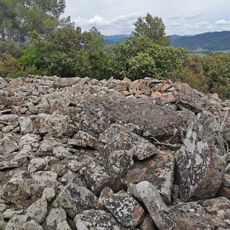
Fenouillet, Mountain summit in Occitanie, France.
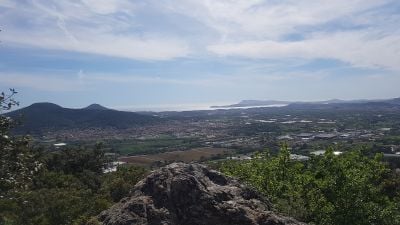
Fenouillet is a hill in the south of the Var department, mainly on the land of Hyères and La Crau, rising behind fields and a tree line. Its summit is a rounded crest with a small rocky knob, covered in dark green vegetation. The hill is built of muscovite mica schists with marbles, psammites and argillites, and the chapel Notre-Dame-du-Fenouillet stands on it.
The hill's rocks belong to the Hercynian orogeny and form the westernmost part of the Maures-Tanneron massif. Graptolite fossils found in a vein near Notre-Dame-du-Fenouillet, the only known fossils of the whole massif, date the sedimentary deposits to the Middle Silurian, about 440 million years ago. The cork oak was exploited here at one time.
The hill's name comes from fenouil, French for fennel, a plant of its open maquis. The chapelle Notre-Dame-du-Fenouillet stands on the hill, and the cork oak woodland was worked for cork in places. The dominant scrub, with tree heath and strawberry tree, marks the acid soils of the mica-schist.
The hill lies mainly in Hyères and La Crau, south of the Var, above the Gapeau valley; the summit is a rounded crest topped by a small rocky knob, reached on foot from the lower slopes. Human building is confined to the base, where vineyards, a sewage plant and a composting factory stand.
The graptolite fossils found near Notre-Dame-du-Fenouillet, in a vein close to the chapel, are the only known fossils of the entire Maures massif; they date the sedimentary deposits to the Middle Silurian, about 440 million years ago.
The community of curious travelers
AroundUs brings together thousands of curated places, local tips, and hidden gems, enriched daily by 93,668 contributors worldwide.