Castel Sainte-Claire, Historical villa in Hyères, France
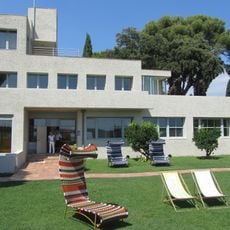
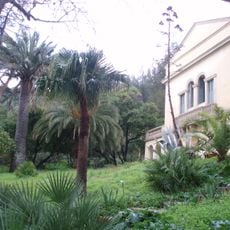
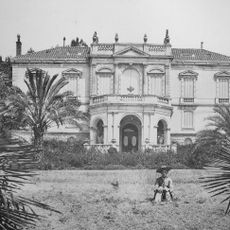
Castel Sainte-Claire is a villa on the hill of Castéou above the old town of Hyères, built from light beige stone blocks with a crenellated roofline and a central porch of two round-arched columns under terracotta tiles. A tall palm stands before the facade. Its 6,500 m² park holds ruins of the town's old ramparts and a ruined tower.
The site held a Clarisse convent built in 1634 on the western part of the old castle's second wall; it was closed in 1790, sold as national property and demolished. In 1849 Olivier Voutier, the naval officer who had brought the Venus de Milo to France in 1820, bought the ruins and built the present villa, where he was buried on 18 April 1877 beside the ruined convent tower. Edith Wharton bought it in 1927 and lived there ten years; the city acquired it in 1957 and has rented it to the Port-Cros National Park since 1990.
Edith Wharton bought the villa in 1927 and laid out the garden as it is today, planting cacti and exotic sub-tropical species on the 6,500 m² grounds. During the ten years she lived here the property drew Anglo-Saxon writers and academics from her circle. The garden is classed among the Remarkable Gardens of France.
The 6,500 m² garden sits on the Castéou hill just above Hyères' old town, next to the Saint-Bernard park and adjoining the Saint-Paul collegiate church, with a view over the Hyères roadstead. Paths run between the villa, the ruined ramparts and Voutier's grave by the old tower, so expect slopes. The villa itself houses the Port-Cros National Park offices and is not open as a museum.
Olivier Voutier, who brought the Venus de Milo to France in 1820, asked to be buried on the property; his grave lies beside the ruined tower of the former convent. The site also holds remnants of Hyères' old city walls, which Voutier himself restored between the villa and the tower.
The community of curious travelers
AroundUs brings together thousands of curated places, local tips, and hidden gems, enriched daily by 93,694 contributors worldwide.