Musée départemental Alexandre-Franconie, Regional museum in Cayenne, French Guiana.
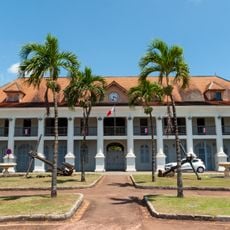
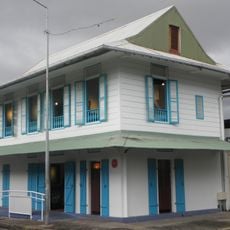
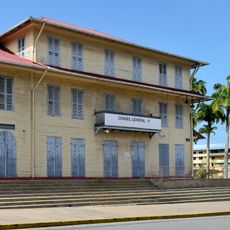
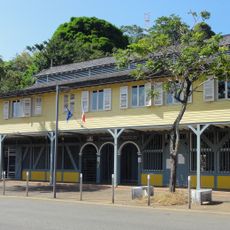
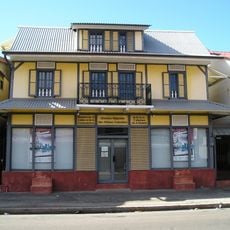
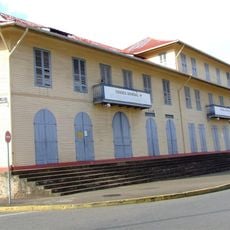
The Musée départemental Alexandre-Franconie occupies the Immeuble Franconie, a two-storey building with pale yellow horizontal siding, a red metal roof and grey louvered double doors; a white sign between the floors reads "CONSEIL GENERAL". Built between 1824 and 1842, the house has a wooden frame filled with brick and its oldest part follows a U-shaped plan around a small garden. The museum displays collections of natural history, archaeology, ethnology and local history.
The museum was founded in 1901 after French Guiana's pavilion gained attention at the 1900 Paris Universal Exhibition, creating a need for a permanent collection space. The building that houses it was constructed between 1824 and 1842 and was later converted to serve this cultural purpose.
The museum's name honours Alexandre Franconie, a philanthropist whose son Gustave, a deputy, sold the family house to the local administration in 1885 and bequeathed the library that still bears the name. Among the displays are about 4,000 insects collected by Father Yves Barbotin, Aristé culture funeral urns from Ouanary, and paintings of penal colony scenes by Francis Lagrange, known as Flag.
Access to the museum and its library is via staircases along Avenue De Gaulle, with a ramp for visitors with reduced mobility. The building is made of a timber frame filled with brick, and the oldest part is arranged in a U around a small inner garden. The museum continues into an extension inaugurated in 2003.
The building received the Maisons des Illustres label in 2011, not a renovation. Its oldest section has a U-shaped plan around a small interior garden, and the structure is a wooden frame filled with brick, as in most Creole houses. The museum was extended in 2003.
The community of curious travelers
AroundUs brings together thousands of curated places, local tips, and hidden gems, enriched daily by 94,590 contributors worldwide.