Gibet du Mont Justicier, Classified gallows on Mont Justicier in La Turbie, France.
The gibet du Mont Justicier is the surviving remnant of a gallows on the summit of Mont Justicier in La Turbie. Of the two stone columns that once carried a horizontal beam, one shaft still stands, pale beige and grey, built of irregular stones set in mortar, with a jagged notch in its left side and a broken top; the other is reduced to a stump. Both rest on a wider base of flat stone slabs among low vegetation, with a wooded hillside behind.
From the Middle Ages, Mont Justicier was reportedly used for executions. The two pillars of the gallows appear on maps of La Turbie from the early 17th century; the gallows consisted of two columns joined by a horizontal beam, of which one shaft survives and the other is reduced to a stump. The 17th-century gallows and the ground within 20 metres of their feet were classified as a monument historique on 20 January 1944.
The name Mont Justicier refers to the hill's role as a place of execution, and the two forked pillars appear on maps of La Turbie's territory from the early 17th century. The surviving pillar and the ground within 20 metres of the forks were classified as monuments historiques on 20 January 1944.
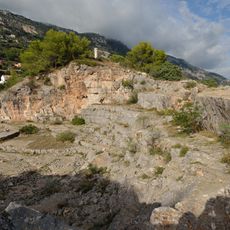
The two pillars stand on the summit of Mont Justicier above La Turbie, reached on foot along hill paths; the ground within 20 metres of their bases is part of the protected monument, so stay on the paths. The surviving shaft and the stump are best seen in low light, when the notch and broken top edge stand out against the sky.
This monument stands in close proximity to the ancient Via Julia Augusta, an important Roman trade road that once crossed this region. This nearness shows how different historical eras converge at this location.
The community of curious travelers
AroundUs brings together thousands of curated places, local tips, and hidden gems, enriched daily by 94,487 contributors worldwide.