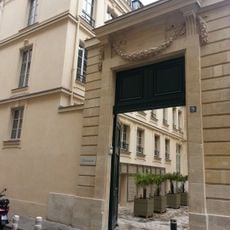
Hôtel du 120 rue du Bac, a private mansion in the 7th arrondissement of Paris
The Hôtel du 120 rue du Bac is a stone private mansion built in the early 1700s in the 7th arrondissement of Paris. Its facade features classical French architectural details with sculpted elements below the windows and around the entrance door, while a symmetrical courtyard with arched passageways marks its rear section.
The mansion was built in the 17th century for a nobleman. During the French Revolution it was confiscated, then sold in the early 19th century. François-René de Chateaubriand moved in in 1838 and died there on 4 July 1848; a commemorative plaque honours him. It was listed as a monument historique on 10 May 1926.
A commemorative plaque honours François-René de Chateaubriand, who moved into this mansion in 1838 and died here on 4 July 1848. The building remains a private residence, so the plaque and the red doors with carved medallions are what passers-by see from the street.
The mansion is a private residence and cannot be visited inside; the facade is seen from the street, where the blue plaque marked "120" sits right of the red double doors. The two grilles on the left belong to the ground-floor and first-floor windows. Rue du Bac is a walking street of the 7th arrondissement, near the Musée Rodin and the Bon Marché.
The commemorative plaque honouring Chateaubriand is not the only trace of the writer: the neighbouring mansion at no. 118, called Clermont-Tonnerre, is identical to this one, built by the same architect Claude-Nicolas Lepas-Dubuisson and decorated by the sculptors Dupin and Toro. In the 1950s the consul, collector and art dealer Jean-Georges Rueff and his wife Marie-Paule lived here.
The community of curious travelers
AroundUs brings together thousands of curated places, local tips, and hidden gems, enriched daily by 94,050 contributors worldwide.