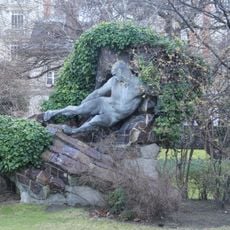
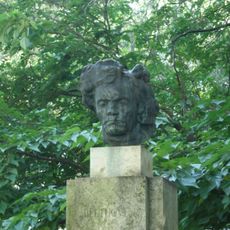
Phidias, Bronze sculpture in Jardin du Luxembourg, France
The Phidias statue by Aimé Millet (1887) shows a bearded man in a belted draped tunic, a small rectangular object in his right hand, his left arm resting on a tall pillar inscribed AGENAS with a carved palm frond; a smaller draped figure stands atop the pillar.
Phidias, the sculptor of the Parthenon's Athena Parthenos and the Zeus at Olympia, worked in Athens in the 5th century BCE. Aimé Millet's statue was inaugurated in 1887, part of a series of figures of artists and thinkers placed in the Jardin du Luxembourg. The marble pedestal carries the Greek inscription ΑΘΕΝΑΙΑΙ and a carved palm frond.
The figure honors an artist who shaped how Europeans understood ancient Greek craftsmanship and artistic ideals. It represents a bridge between French sculptors and the classical world they admired and studied.
The statue stands along the terrace edge facing the garden's central basin, near the row of commemorative figures of artists and thinkers. Visitors approach on foot through the gravel paths; the pedestal inscription ΑΘΕΝΑΙΑΙ and the carved palm frond are best read up close. The stone shows greenish staining, so details read more clearly in raking morning light.
This work shares the garden with other sculptures depicting celebrated thinkers and artists from different eras. Together they form an open-air gallery where visitors encounter multiple figures from various periods of history.
The community of curious travelers
AroundUs brings together thousands of curated places, local tips, and hidden gems, enriched daily by 93,242 contributors worldwide.