Pont ferroviaire Moulins, Railway bridge in Moulins, France
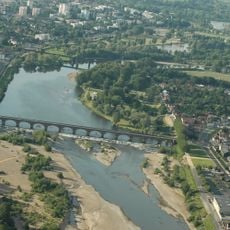
The Pont de fer, also called Pont noir, is a 316.5-metre girder bridge over the Allier at Moulins, with nine spans: seven of 40–42 m and two end spans of 18.25–19.25 m. Its deck rests on eight pairs of cast-iron columns filled with concrete, linked by X-shaped bracing and standing on cylindrical stone piers. Riveted sheet-iron side girders give the bridge its dark colour.
Designed by Belgian engineers Basile Parent and Pierre Schaken, the bridge was built between October 1857 and July 1859 by the Paris firm J.F. Cail & Cie to complete the Moulins–Montluçon line, opened on 7 November 1859. It was among France's first metal bridges and the first whose piers were sunk using compressed air. A metre-gauge track was added in 1886; passenger service ended in 1972 and freight in 1980.
Locals call it pont de fer (iron bridge) or pont noir, after the black riveted side girders. Since 6 May 2021 it has carried pedestrians and cyclists instead of trains, with a wooden oak deck and a glazed belvedere balcony over the Allier. The conversion was the first of its kind in France, with SNCF Réseau keeping ownership and Moulins Communauté holding a 30-year concession.
Since May 2021 the bridge has been open to pedestrians and cyclists, with access ramps from the towpaths on both banks of the Allier. A glazed belvedere balcony has been fitted on the structure. The deck is reached on foot or by bike only; the old rails and sleepers were removed in 2019.
The bridge was the first in France whose piers were sunk using compressed air; the cast-iron tubes served as caissons during construction. Look for the white "50.49" painted at the right end of the dark girder. Since the 1950s it has also carried a water main from the left bank to reservoirs on the right bank.
The community of curious travelers
AroundUs brings together thousands of curated places, local tips, and hidden gems, enriched daily by 94,315 contributors worldwide.