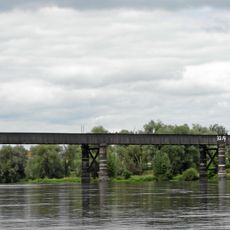
Freyssinet Test Arch, Concrete test arch in Moulins, France
The Freyssinet Test Arch is a 50-metre-span, lightly reinforced concrete arch built in 1909 in Moulins. It is only 1.50 m wide at the crown and 2.50 m at the springings, with a rise of just 2 m, and weighs 130 tonnes. A concrete tie between the abutments, compressed by 1,200 steel wires, resists its 300–400 tonne thrust at each end.
Eugène Freyssinet built the arch in 1909 on the site of a former departmental railway station in Moulins. He used it to test lifting a 50-metre span off its centring by compressing the concrete, a method he then applied to the Veurdre, Boutiron and Châtel-de-Neuvre bridges over the Allier. The arch was listed as a monument historique in October 2021.
The arch's name comes from its builder, Eugène Freyssinet, an engineer for the Allier department who later patented prestressed concrete in 1928. The 1,200 steel wires tensioned between the abutments here were an early, unpatented use of that idea. The structure stands near the crossing of rue de Narvik and rue de Lyon, beside the former Moulins–Montluçon railway line.
This structure sits on private property along rue de Lyon and is partly buried in the ground, which limits visitor access. Check ahead about viewing possibilities before planning a visit.
The arch's lateral thrust is held by a concrete tie beam compressed by 1,200 steel wires of 10 mm, tensioned to 2,000 tonnes against a thrust of 600 to 800 tonnes. Freyssinet thus built a prestressed tie as a side effect, though he only filed the patent in 1928.
The community of curious travelers
AroundUs brings together thousands of curated places, local tips, and hidden gems, enriched daily by 93,140 contributors worldwide.