Conche Verte, Neolithic menhir in Olonne-sur-Mer, France
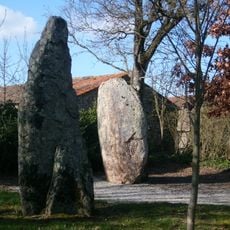
Conche Verte is a menhir of micaschist at Olonne-sur-Mer, in Les Sables-d'Olonne, Vendée. Now re-erected, the block stands 3.15 m high, 1.50 m wide and up to 0.50 m thick at the base, tapering to a rounded top. Its coarse grey-brown surface is mottled with lighter patches, a vertical ridge runs up the face, and a notch cuts into the lower left edge.
The stone dates back to the Neolithic period and was part of an early settlement system along the western French coast. Early 20th-century archaeological work uncovered traces of tools and stones buried beneath the monument.
The name Conche Verte refers to the cove setting, and the stone is also called the menhir of the Ermitage de Saint-Vivence. It was mentioned as early as 1865 and was rediscovered under the dune by Marcel Baudouin in 1901. A polished amphibolite axe fragment found during his excavation is a detail to look for in local collections.
The menhir stands on open sandy ground among low vegetation, not in a forest. It was found buried under the dune in 1901 and re-erected, so the stone now rises 3.15 m from bare soil. Approach on foot over sand; the ground is uneven and there is no marked path or parking area recorded.
Beneath the stone lies a layer of darkened earth showing that sand dunes formed after the monument was erected. This reveals how much the coastal landscape has shifted over thousands of years.
The community of curious travelers
AroundUs brings together thousands of curated places, local tips, and hidden gems, enriched daily by 94,651 contributors worldwide.