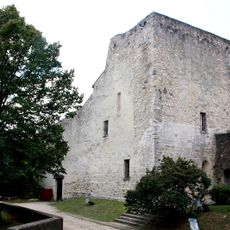
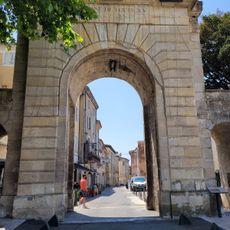
Collégiale Sainte-Croix, Medieval collegiate church in Montélimar, France.
The Collégiale Sainte-Croix is a Gothic collegiate church whose nave is covered by a brick vault built in 1818, with a rounded apse surviving from the medieval building. Its bell tower, rebuilt between 1555 and 1557 in an Italian Renaissance style inspired by the Capitoline Hill in Rome, rises 35 metres. Inside, a dark wooden screen of carved pointed arches spans the apse below three tall stained-glass windows.
The church is first documented in 1183, in a bull of Pope Lucius III naming it as property of the Abbey of Île-Barbe in Lyon; only the lower part of the bell tower survives from that Romanesque building. On 10 June 1449 Pope Nicholas V raised it to a collegiate church at the request of the Dauphin Louis, and it was enlarged in Gothic style between 1489 and 1499. Protestant troops from Nîmes sacked it in 1567, burning altars, statues, bells and the relics of Saint Hébrard; rebuilding began in 1577 and ended in 1606, leaving only the apse of the medieval church.
The bell known as "la Calvine" came from Montélimar's Protestant temple, demolished after Louis XIV revoked the Edict of Nantes in 1685, and was then hung in the collegiate church. In 1600 Marie de Médicis, passing through, gave 1,000 écus, which paid for three new bells. A wooden jacquemart covered with lead was commissioned from the carpenter Jacques Pavin in 1616.
The church stands in the old centre of Montélimar, a short walk from the town's main squares. The 35-metre Renaissance bell tower, rebuilt between 1555 and 1557, is the easiest landmark to aim for when finding the building. Look for the 1606 date carved beneath a Gothic window, which marks the end of the reconstruction. The interior is entered from the street side; visitors should keep to the aisles during services.
The lower part of the bell tower is all that survives of the Romanesque church mentioned in a bull of Pope Lucius III in 1183. The tower was rebuilt between 1555 and 1557 in an Italian Renaissance style modelled on the Capitoline in Rome, and a statue of the Virgin placed on top was removed in 1984 because it had decayed.
The community of curious travelers
AroundUs brings together thousands of curated places, local tips, and hidden gems, enriched daily by 92,793 contributors worldwide.