Chapelle de la Villa Algérienne, Moorish Revival chapel in L'Herbe, Lège-Cap-Ferret, France.
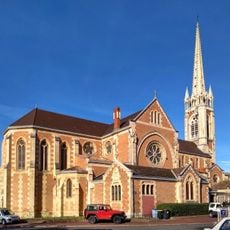
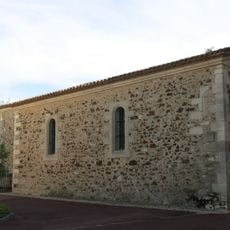
The Chapelle de la Villa Algérienne, also called chapelle Sainte-Marie-du-Cap, stands in the village of L'Herbe in Lège-Cap-Ferret, on the Arcachon basin. Built in 1884-1885 to plans by architect Jean-Eugène Ormières, it has a central facade with two flanking towers painted in alternating red and white bands, a pointed polylobed horseshoe arch entrance, an arcaded loggia of three small arches, and a square panel inscribed "GLORIA DEI".
Léon Lesca, a public works contractor born in La Teste who had helped build the port of Algiers, bought land here with his brother in 1863 and built his Villa algérienne estate from 1865. Architect Jean-Eugène Ormières, later mayor of Arcachon, designed the chapel, completed in 1884-1885 and blessed on 8 September 1885 by abbé Lacouture. Lesca obtained authorisation from President Jules Grévy; the family later gave the chapel to the Archdiocese of Bordeaux, and it was listed as a monument historique in 2008.
The chapel's name recalls the estate of Léon Lesca, who returned from Algeria and built a Moorish-style villa here; the chapel served the oyster-farming villages around L'Herbe. On the bell tower a cross stands beside a crescent moon, with a Latin inscription "Gloria Deo" and an Arabic one meaning "welcome to you". Inside hangs a wooden chandelier of glass, porcelain and coloured fabric pompons, and a five-pointed star referring to the five pillars of Islam, the five books of the Torah and the five wounds of Christ.
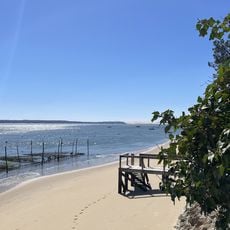
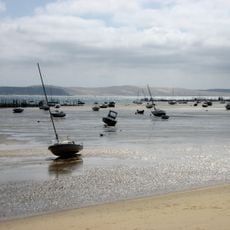
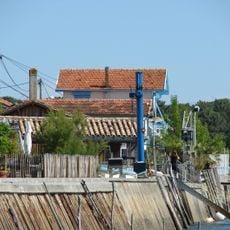
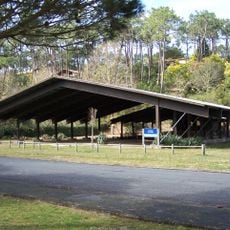
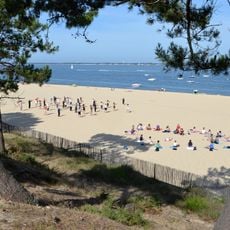
The chapel stands in the village of L'Herbe, on the edge of the Arcachon basin, and is reached on foot through the surrounding forest, as worshippers once did. Masses are held in summer, and the building also hosts weddings, baptisms and concerts. It remains consecrated for Catholic worship.
The bell tower pairs a cross with a crescent moon, and the facade carries a Latin inscription, "Gloria Deo", beside an Arabic one meaning "welcome to you". Léon Lesca, who had worked on the port of Algiers, had the chapel built as a sign of openness and peace.
The community of curious travelers
AroundUs brings together thousands of curated places, local tips, and hidden gems, enriched daily by 93,489 contributors worldwide.