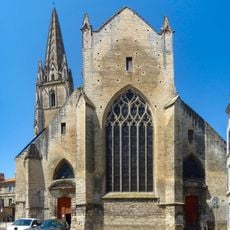
Église Saint-Hilaire, Registered historical church in Niort, France.
Église Saint-Hilaire is a Romano-Byzantine church in Niort built to designs by Pierre-Théophile Segretain, in the shape of a Latin cross on a basilica plan with three naves of equal height. The central vessel is separated from the side aisles by large trefoil or quatrefoil piers topped with Corinthian capitals, each carved differently. The sober façade has three round-arch portals flanked by Corinthian columns, the two side ones walled up, a rose window above the main portal, and a statue of Saint Hilaire between Saints Ambrose and Athanasius on the central gable.
Built at the request of Bishop Louis-Édouard Pie as the Brèche district grew around the 1856 railway station, the church was funded half by Napoleon III and half by the city of Niort, with mayor Paul-François Proust as a driving force. Work ran from 1862 to 1866, and the church was consecrated in 1868. It was listed as a monument historique in 2015.
The 1867 stained glass comes from the Dragant workshop in Bordeaux and the Lobin workshop in Tours, with some medallions dated 1900. Bishop Louis-Édouard Pie personally chose and paid for a third of the windows. Look for local saints and, in the triple lancet of the apse, a red-backed Coronation of the Virgin.
The crypt beneath the choir is closed to visitors for safety reasons, so the accessible interior is the nave, side chapels and transepts. The church stands in the Brèche district, a short walk from Niort's railway station, whose opening in 1856 drove the neighbourhood's growth.
The crypt under the choir is closed for safety reasons, and only one priest is buried there, though it was meant as the burial place for the parish priests of Saint-Hilaire. The church's three bells in the northwest tower are named Élisabeth, Isabelle and Hélène.
The community of curious travelers
AroundUs brings together thousands of curated places, local tips, and hidden gems, enriched daily by 93,106 contributors worldwide.