Vardzia, Cave monastery in Samtskhe–Javakheti, Georgia.
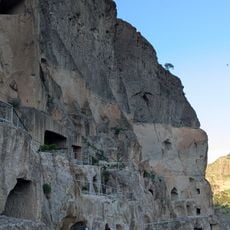
Vardzia is a cave monastery built into a cliff face in the Samtskhe–Javakheti region, extending for several hundred meters along the rock wall. The site contains hundreds of rooms carved directly into the stone and stacked across multiple levels to form an intricate underground settlement.
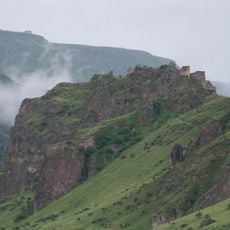
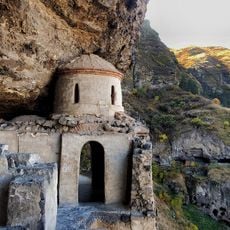
Construction began under King George III (1156–1184), who laid out the site and had the first cave dwellings cut near a spring. Between his death and Tamar's marriage in 1186 the Church of the Dormition was carved out and painted, funded by the eristavi Rati Surameli. Further dwellings, defences and a 3.5 km aqueduct followed until about 1203. The monastery was sacked by Shah Tahmasp I's Persian troops in 1551 and abandoned after the Ottoman takeover in 1578.
The Church of the Dormition displays wall paintings that show how medieval artists expressed their religious understanding through visual imagery. Pilgrims and visitors could deepen their spiritual connection by spending time with these sacred images.
The best way to visit is by heading from Akhaltsikhe, which is itself reachable by public transport from larger cities in the region. For exploring the site, wear shoes with good grip and plan to spend enough time navigating through the different levels and chamber sections.
The monastery's water came from Zeda Vardzia through a 3.5 km aqueduct, feeding a tunnel that ends at a cold water pool beside the Church of the Dormition. The complex also had 185 wine jars sunk into the floors of its cellars, showing how central winemaking was to the monastic economy.
The community of curious travelers
AroundUs brings together thousands of curated places, local tips, and hidden gems, enriched daily by 93,314 contributors worldwide.