Samtavisi Cathedral, Orthodox cathedral in Kaspi Municipality, Georgia.
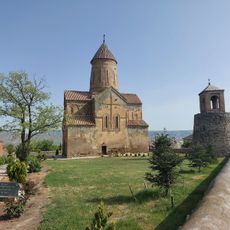
Samtavisi Cathedral is a medieval Georgian Orthodox cathedral in rural Kaspi Municipality, Georgia, built on a rectangular plan with a dome resting on four interior pillars. On its northern side stand a two-story bishop's residence, a small chapel, and a three-story bell tower.
A monastery was founded at this site in the 6th century by an Assyrian missionary, making it one of the early centers of Christianity in Georgia. The stone cathedral seen today was raised in the 11th century, replacing the earlier religious buildings on the same ground.
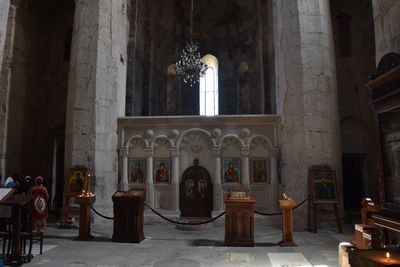
The name Samtavisi means "head of the tavisi" and the cathedral is the seat of the Samtavisi and Gori Eparchy. Inside, 17th-century frescoes painted in 1679 under Bishop Meliton survive in the dome and apse, showing Christ Pantocrator, seraphs, evangelists and the Deesis in dark brown, blue, yellow and dark grey.
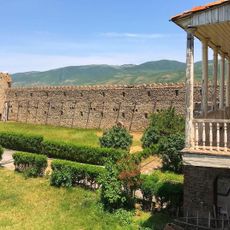
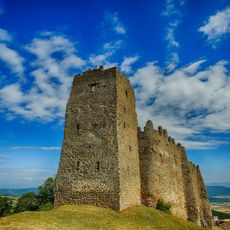
The cathedral stands on the left bank of the Lekhura River, about 11 km from Kaspi and near Igoeti village. The complex is enclosed by a 3–5 m stone and brick wall with a rounded tower; the 16th–17th-century bell tower built into the northern wall has a gate on its ground floor. The grounds include a small church and a ruined two-story bishop's residence, so surfaces may be uneven.
The five-arched eastern facade is the only part of the cathedral that survived the earthquakes intact. In its right arch is a carved gryphon relief; a second gryphon was lost in the 19th-century restoration by the architect Ripardi. The facade also carries the lost inscription naming Bishop Hilarion as builder in 1030.
The community of curious travelers
AroundUs brings together thousands of curated places, local tips, and hidden gems, enriched daily by 94,505 contributors worldwide.