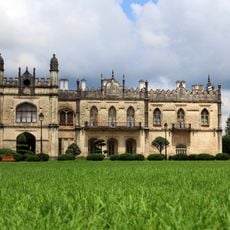
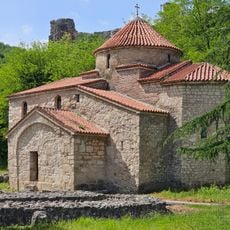
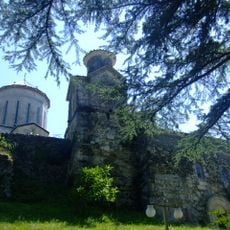
Tsalenjikha Cathedral, Orthodox cathedral in Tsalenjikha, Georgia.
Tsalenjikha Cathedral is an Orthodox church building in the Samegrelo-Zemo Svaneti region featuring a central cross-domed design. The structure includes three arcaded galleries surrounding the main space and a two-story bell tower positioned at the northwestern corner.
No construction inscription or historical record of the founding survives; in 1913 Ekvtime Takaishvili dated the church to the 10th–11th centuries. In the 14th century Vameq I Dadiani added open columned galleries on three sides, and the north and south parts were later converted into Dadiani burial chapels. In the 1640s Levan II Dadiani established a bishopric here, abolished in the 18th century; the church was closed in Soviet times and services resumed in 1988.
The cathedral was the burial place of the Dadiani rulers: Levan II Dadiani and his wife Nestan-Darejan rest in the west chapel, and the Lipartiani family were also buried in the courtyard. A 17th-century fresco on the chapel's south wall shows Levan, Nestan-Darejan and their children holding a model of the church. In 1665 the Patriarch of Antioch, Macarius, visited the cathedral.
The cathedral stands on a low hill on the left bank of the Chanistskali River, at the edge of Tsalenjikha, about 30 km from Zugdidi. The grounds are enclosed by a wall with a two-storey bell tower at the northwest corner and a half-collapsed tower on the south side. The ruined lower storey of the Dadiani palace and a damaged tunnel about 40–45 m long lie west of the church.
A Byzantine artist named Cyrus Emanuel Eugenicus painted elaborate frescoes on the interior walls during the late 14th century. These murals display complex iconographic scenes but currently require significant restoration to prevent further deterioration.
The community of curious travelers
AroundUs brings together thousands of curated places, local tips, and hidden gems, enriched daily by 94,420 contributors worldwide.