Hercules Gate, Roman gate in Pula, Croatia
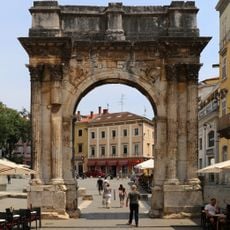
The Hercules Gate is the oldest preserved monument of Roman architecture in Pula, built in the mid-1st century BC. Its opening is 3.60 metres wide and over 4 metres high, framed by regularly cut stone blocks. On the central front block of the arch, a bearded head with curly hair is carved in high relief, with a club visible to its left.
Built in the mid-1st century BC, the gate is the oldest surviving monument of Roman architecture in Pula. Its arch inscription names the duumvirs Lucius Calpurnius Piso Caesoninus and Lucius Cassius Longinus, whom the Roman Senate sent to the bay of Pula to organise the colony between 47 and 44 BC. Longinus was the brother of Gaius Cassius Longinus, one of Caesar's assassins, which fuels debate over the exact founding year of Pula.
The carved head of Hercules above the gate shows a bearded man with curly hair and a club, embodying the ancient guardian figure of the city. This image served as an important symbol of power and protection for the Romans in Pula.
The gate stands on Ulica Sergijevaca, at the point where the upper circular street once passed through it, so its axis sits at an angle to the line of the former walls. The opening is 3.60 m wide and over 4 m high, framed by regularly cut stone blocks; the relief and inscription are on the central arch block, so look up as you pass beneath.
The gate's axis is tilted relative to the line of the walls because the upper circular street of the Roman town passed through it on a slope. The opening is 3.60 m wide and over 4 m high, framed in regularly cut stone blocks.
The community of curious travelers
AroundUs brings together thousands of curated places, local tips, and hidden gems, enriched daily by 93,461 contributors worldwide.