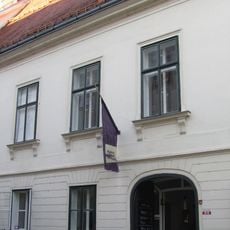
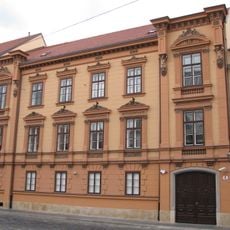
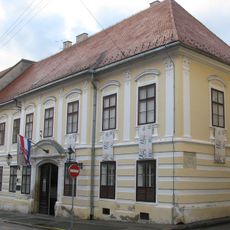
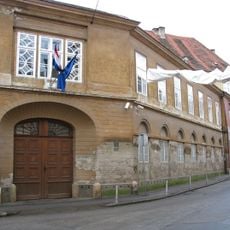
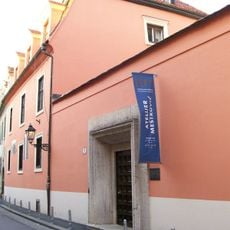
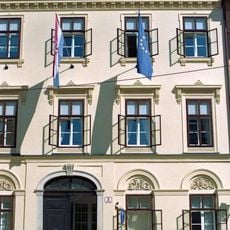
National Home palace, Neoclassical palace in Gornji Grad, Zagreb, Croatia.
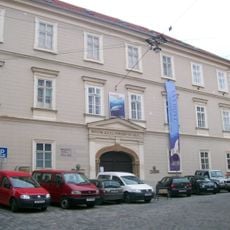
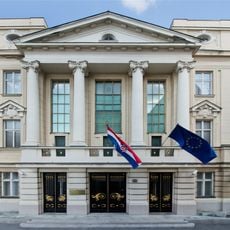
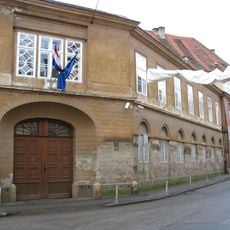
The National Home Palace is a Neoclassical palace at Opatička Street 18 in Gornji Grad, built by the end of 1838 for Count Karlo Drašković and attributed to builder Bartol Felbinger. Its ornamented façades and Classicist interior centre on the Revival Hall, the former Casino or Illyrian Hall, which was partitioned into offices and restored to its original form in 1994.
Count Karlo Drašković bought the abandoned Poor Clares site in 1835 and had the palace finished in late 1838, probably by builder Bartol Felbinger. The Drašković family never settled there, and on 27 February 1846 the Illyrian movement bought it for 28,000 silver florins and renamed it National Home. From 1868 to 1880 it housed the Yugoslav Academy, then the Table of Seven supreme court until 1945.
The central hall of the palace served as a meeting place for Croatian intellectuals and artists during the 1800s. It hosted important gatherings that shaped the city's cultural life.
The building now houses the Institute for the History of Croatian Literature, Theatre and Music and is not open to the public as a museum. Visitors can appreciate the external architecture and its location in Gornji Grad, the upper part of the old city.
The palace was finished in late 1838, not 1843; that year the altana, an open balcony, on the east façade collapsed and Felbinger was sued. Its three surviving blueprints, held in the Croatian History Museum, are unsigned and undated, so his authorship rests on that lawsuit.
The community of curious travelers
AroundUs brings together thousands of curated places, local tips, and hidden gems, enriched daily by 92,841 contributors worldwide.