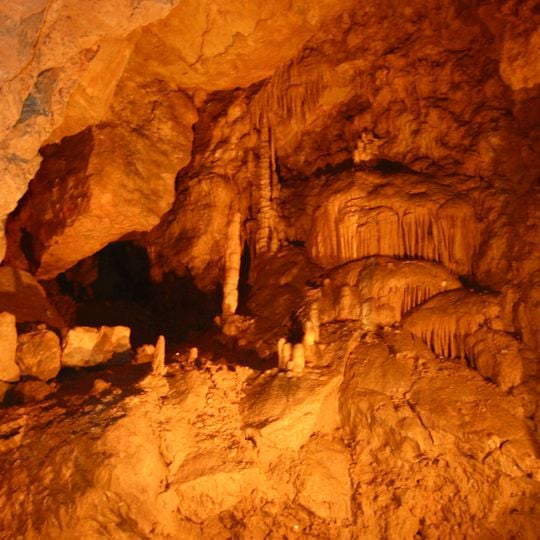
Abaliget Cave, Karst cave in Mecsek Mountains, Hungary
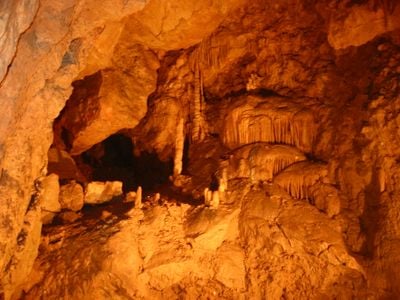
Abaliget Cave is a stream cave in grey Triassic limestone on the Bodó-hegy slope, with a main branch of about 466 m open to visitors and a 25–30 m entrance passage so low that it must be crossed bent over. Its walls carry named dripstone forms such as the Crown, the Pisai leaning tower and the Elephant Head, and the main branch ends at the large Nagy Dóm hall, from which a steel staircase climbs 18 m to the Nagy-terem, discovered in 1954.
The cave was discovered in 1768 and placed under nature protection in 1941. In 1921 the name Abaligeti-barlang appeared in the literature. Vince Kölesi found human-laid stone steps in the Library section, still there in the early 1900s but gone by the 1950s construction. The Great Hall was discovered in 1954.
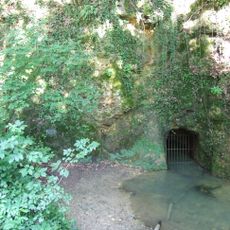
The cave's name Paplika, used in old records, refers to a rock cavity; locals also knew it as Nagy Paplika. Research on its bats began in 1923, and Antal Gebhardt's 1934 survey recorded 190 animal species, including the blind amphipod Niphargus forelli gebhardti named after him. A stream flows out of the entrance chamber.
The developed main branch runs about 466 metres and is visited only with a guide; the first 25–30 metres are so low that you walk bent over. Sections outside the show route need a permit from the Danube–Drava National Park Directorate. The tour ends at the Nagy-terem hall, reached by a slender rust-proof steel staircase, and returns along the same route.
About 160 metres from the entrance, opposite a formation called the Statue of Florian, the Florian Spring feeds the cave stream in one of the widest chambers, where asthma patients once took therapeutic courses. The stream emerges at the sump end of the main branch, about 40 metres beyond the Hell's Throat opening.
The community of curious travelers
AroundUs brings together thousands of curated places, local tips, and hidden gems, enriched daily by 92,633 contributors worldwide.