Lakihegy Tower, Radio tower in Szigetszentmiklós, Hungary
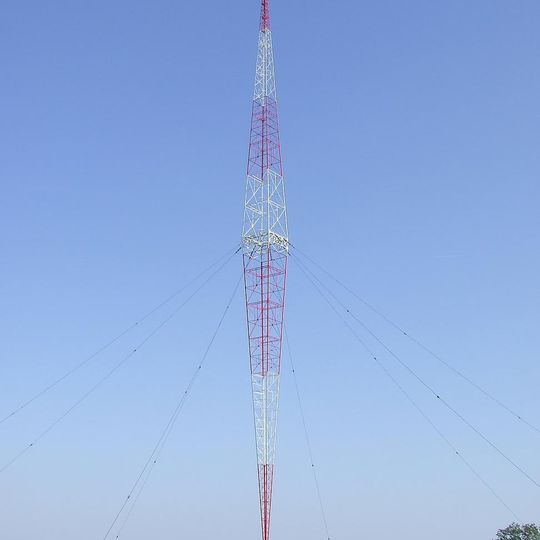
Lakihegy Tower is a 314-metre guyed radio mast of the Blaw-Knox type, its elongated octahedral steel lattice tapering from 0.65 m at the base to 14.65 m at mid-height and 1.39 m at the top. Eight 220-metre guy cables anchored to 88-tonne concrete blocks hold it upright, and a retractable tuning tube adds about 30 m. The 280-tonne structure stands south of the road junction at Szigetszentmiklós-Lakihegy.
The 120 kW transmitter and its self-radiating Blaw-Knox mast, adapted to the sandy Csepel Island soil by engineer Pál Tantó, entered service on 2 December 1933, opening with a speech by Prime Minister Gyula Gömbös on Budapest I. On 30 November 1944 retreating German troops cut six of the eight guy ropes with explosives, bringing the mast down. Rebuilt, it resumed broadcasting on 22 December 1946, first at 50 kW and from 1948 at 135 kW; a 300 kW transmitter followed in 1968.
The tower stands as a landmark of radio broadcasting history in Hungary and has shaped the local skyline for generations. People in the area see it as an integral part of their surroundings.
The tower stands south of the junction of the 5101 road and Massányi Károly út, on the border between Lakihegy and Halásztelek. It is on private industrial ground and cannot be climbed; the 314-metre steel structure and its eight guy cables are best seen from the surrounding roads. The site is outside Budapest's administrative area, in Szigetszentmiklós.
The tower's 314-metre steel structure weighs 280 tonnes and is held upright by eight 220-metre guy ropes anchored to 88-tonne concrete blocks, each under 70 tonnes of tension. At the top, a retractable tuning tube of 36 metres extends about 30 metres beyond the framework.
The community of curious travelers
AroundUs brings together thousands of curated places, local tips, and hidden gems, enriched daily by 92,634 contributors worldwide.