Museum of Fine Arts, Budapest, Art museum at Heroes' Square, Budapest, Hungary
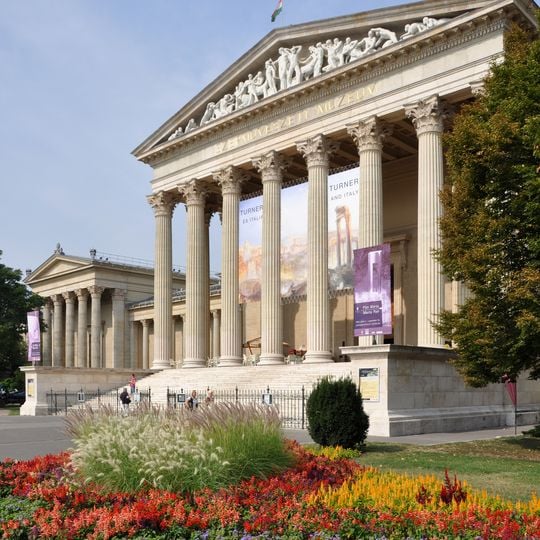
The Museum of Fine Arts (Szépművészeti Múzeum) stands on Heroes' Square facing the Hall of Art, built 1900–1906 to plans by Albert Schickedanz and Fülöp Herzog in an eclectic-neoclassical style. Its pale stone facade rises on a rusticated base reached by a broad flight of steps; eight fluted columns with ornate capitals carry a deep entablature, and the pediment above is filled with a sculpted group of figures. The frieze reads "SZÉPMŰVÉSZETI MÚZEUM". Behind the front, a neo-Renaissance picture wing and a neo-classical entrance block enclose inner courts, with colonnades along the lower wings and a long colonnade above.
The museum was decided by the 1896 millennium law, and after a design competition won by Albert Schickedanz and Fülöp Herzog it was built between 1900 and 1906, the neo-Renaissance picture wing first, then the neoclassical front block. King Franz Joseph inaugurated it on 1 December 1906 and it opened to the public on 5 December. Near the end of World War II many works were taken west and the building was badly damaged; most pieces were recovered in 1945–47 and the Old Gallery reopened in 1949. The Hungarian material passed to the National Gallery in 1957.
The Egyptian collection numbers about 3,500 objects, among them painted mummy sarcophagi. Much of it was bought together by the Egyptologist Eduard Mahler in the 1930s, and later digs in Egypt added to it. The museum's six departments also cover classical antiquities, old sculpture, old master paintings, drawings and prints, and art after 1800.
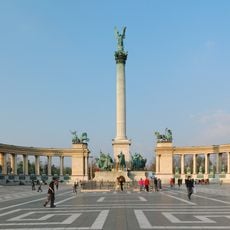
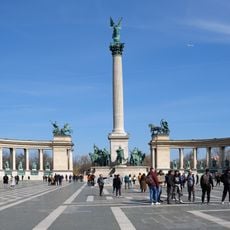
The museum faces Heroes' Square, with the entrance reached by the broad flight of steps below the eight-columned facade. The building was closed for renovation until 30 October 2018, when the renewed halls reopened; the Romanesque Hall had already reopened on 15 March 2018 after nearly 70 years as a closed storeroom. The 2015–2018 renovation covered about 40% of the building and made the institution fully accessible.
The Egyptian collection includes a fully painted sarcophagus from the Ptolemaic period, whose colors have survived for over two millennia. The inscriptions show protective spells and religious formulas meant to secure the deceased's passage into the afterlife.
The community of curious travelers
AroundUs brings together thousands of curated places, local tips, and hidden gems, enriched daily by 92,657 contributors worldwide.