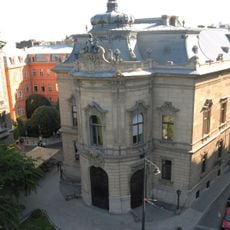
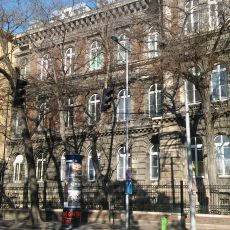
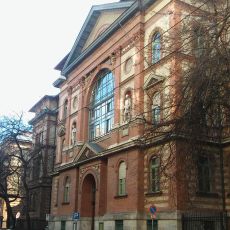
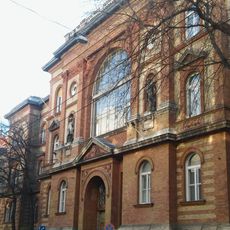
Kálvin Square Reformed Church, Reformed church at Kálvin Square, Budapest, Hungary
Kálvin Square Reformed Church is a house of worship featuring neoclassical design located in Budapest's District IX. The building presents a four-columned entrance portico and a tower that was added during renovations to the original structure.
Construction of this church took place from 1816 to 1830 according to designs by architect Vince Hild. The building emerged during a period when Budapest was being reshaped, and it was later modified to serve the changing needs of the congregation.
The square in front of the church was called Heumarkt until 1874, when it was renamed Kálvin tér after the reformer John Calvin; a statue of Calvin by sculptor Barna Búza stands before the building. The tower is topped by a star, a symbol typical of Reformed churches in the former Kingdom of Hungary, pointing to Bethlehem and the finding of Christ.
The church faces Kálvin tér, the square renamed in 1874 after John Calvin, where a statue of the reformer by Barna Búza stands in front of the building. The surrounding streets hold the Reformed University, the Reformed Church grammar school, the Bible Museum and a bookshop. The square is among the busiest in Budapest, so expect crowds around the nearby market hall and metro entrances.
The tower rests on the inner edges of two separate foundations built for twin towers that were planned but never erected, and the church itself stands without a foundation. The single bell, cast in 1980 by Lajos Gombos, weighs 1050 kg, sounds e1 and is 125 cm across; its bronze came from the cracked 1833 predecessor that rang noon on Petőfi Radio from 1933 to 2006.
The community of curious travelers
AroundUs brings together thousands of curated places, local tips, and hidden gems, enriched daily by 92,757 contributors worldwide.