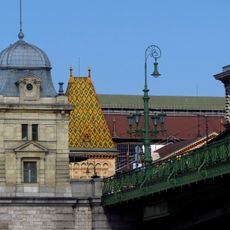
Szerb templom, Serbian Orthodox church in District V, Budapest, Hungary
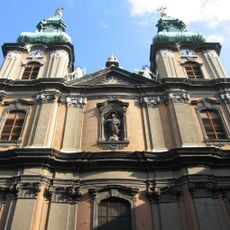
The Szerb templom, dedicated to Saint George the Great Martyr, stands at 4 Szerb utca in Budapest's District V. András Mayerhoffer designed the Baroque church, built in 1733, with a bell tower added in 1752. Inside, a wooden balustrade separates the women's gallery from the men's area, which sits one step lower. The iconostasis, made in 1850, shows Italian Renaissance influence.
Serbian settlers who fled the Turks built a church on medieval foundations between 1695 and 1698, dedicated to Saint George; it was demolished in 1731. The present church was built in 1733 to plans by András Mayerhoffer, and its bell tower was completed in 1752. After the 1838 Pest flood damaged the original iconostasis, a new one was made in 1850.
The church keeps a copperplate engraving of its patron saint from 1701 and an embroidered epitaphios by Hristofor Žefarović showing the burial of Christ. The iconostasis, made in 1850 by a Greek artist after the old one was lost in the 1838 Pest flood, follows a neorenaissance design. The wooden railing between the women's and men's sections reflects the traditional layout of Greek Catholic churches.
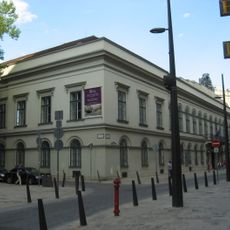
The church stands at 4 Szerb utca in District V, under 100 metres from Váci utca, the main pedestrian street. The entrance gate on Szerb utca dates from 1776; a wrought-iron gate was added in 1932 when the street level was raised. The garden is enclosed by a stone wall, and a ceramic picture of Saint George slaying the dragon sits in a niche at the corner of Szerb utca and Veres Pálné utca.
The garden preserves historical tombstones of Serbian believers buried in Pest, keeping memories of earlier generations of the community alive. These gravestones show how the church remained connected to local Serbian families across many decades.
The community of curious travelers
AroundUs brings together thousands of curated places, local tips, and hidden gems, enriched daily by 92,604 contributors worldwide.