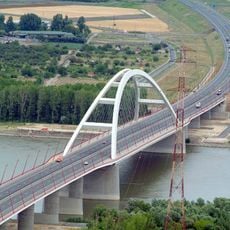
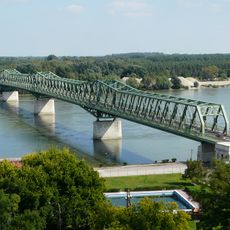
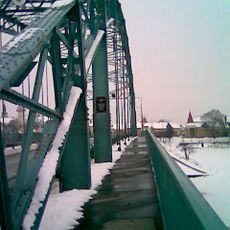
Tass sluice, Lock system in Tass, Hungary.
The Tass sluice, officially the Sajó Elemér Multi-Purpose Water Discharge Structure, stands on the Ráckeve branch of the Danube at the southern tip of Csepel Island, between Tass and Makád. Its navigation lock is 114 m long overall, with an 85 m by 12 m chamber that can handle barges up to 1,300 tonnes. The structure rests on a 2.0 m thick concrete base slab; the lock heads' water-side walls are clad in carved limestone, and the gate pivot walls and corners in granite.
Built between 1926 and 1928 at Tass together with a shipping lock and a hydroelectric plant, the structure was part of the 1904 law on regulating the Ráckeve branch of the Danube. The ice flood of 10 March 1956 undermined the foundations of the plant and discharge lock, which tilted and were later demolished. Drainage was then transferred to the shipping lock, whose upper gates were replaced by a fixed sill, modified in 1962 with a tilting flap for navigation.
The lock gives its name to the Tassi V–VI fishing waters, managed by the Hungarian National Fishing Association (MOHOSZ). The oxygen-rich water below the structure draws zander, bream and burbot, and the Tassi Environmental Fishing Cup is held here each year alongside a clean-up of the banks.
The sluice lies on the Danube at river kilometre 1586.4, east of the main branch, between Tass and Makád. From Tass, follow the road to the Kiskunsági-főcsatorna; the site is also reached from the 51-es főút. The lock chamber is 85 m long and 12 m wide, and the largest vessel it can pass is a 1,300-tonne barge.
The sluice functions as both an engineering structure and a crucial habitat for fish populations that inhabit this section of the river. Visitors often spot birds and observe aquatic life thriving in the controlled water conditions created by the lock.
The community of curious travelers
AroundUs brings together thousands of curated places, local tips, and hidden gems, enriched daily by 94,432 contributors worldwide.