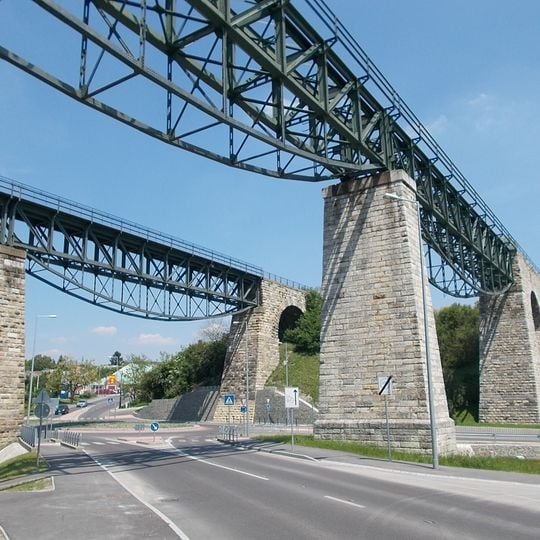
Biatorbágy Railway Viaduct, Railway bridge in Biatorbágy, Hungary
The Biatorbágy Railway Viaduct is a pair of parallel steel truss bridges over the Füzes Stream valley, each about 20–25 metres high. The northern span, built in 1883–84, has a multiple-lattice upper deck; the southern span, added in 1898, is a columnar-lattice truss with a lower deck. Both rest on rough-cut stone piers, and in 1941 a third parabolic belt was added beneath the girders.
The northern bridge was completed in 1884, while the southern one finished in 1898, both serving the Budapest-Hegyeshalom railway line until their closure in the late 1970s. These two phases of construction reflect the expanding railway needs of the region during Hungary's modernization period.
The viaduct stands as a designated historic monument of Hungary, representing the engineering capabilities and railway development of the late 19th century.
The northern bridge carries the Budapest–Balaton cycle path and is open to walkers and cyclists; the southern bridge is closed to crossing, likely for structural reasons. A memorial plaque on the base recalls the 1931 attack. The viaduct sits in the centre of Biatorbágy and is easy to reach from several directions.
On the night of 13 September 1931, Szilveszter Matuska blew one rail of the southern viaduct under the Budapest–Vienna express; the locomotive and several carriages fell about 26 metres, killing 22 people. The structure itself was only slightly damaged and reopened on 3 October 1931. The attack was then used to justify a political purge of illegal communists.
The community of curious travelers
AroundUs brings together thousands of curated places, local tips, and hidden gems, enriched daily by 92,647 contributors worldwide.