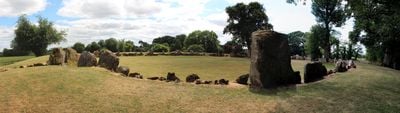
Grange stone circle, Stone circle at Lough Gur, Ireland
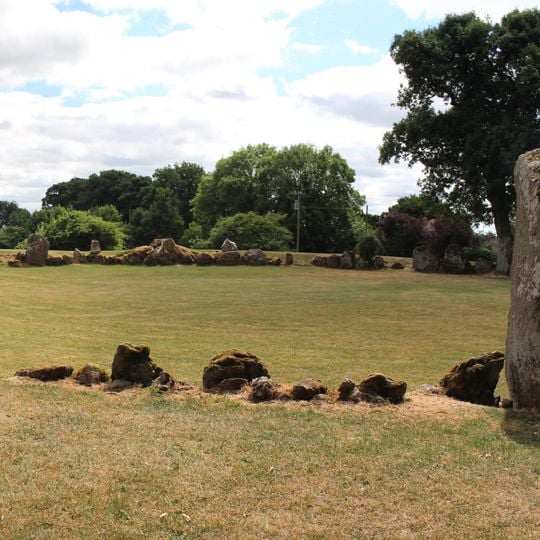
Grange stone circle is a ring of 113 stones, about 48 m across, set inside a low earthen bank roughly 11 m wide and 1.2 m high. Twelve large standing stones are spaced around the circumference, and a passage flanked by big stones leads in. The northern entrance stone, Crom Dubh, is about 2.5 m high and weighs over 50 tonnes.
Grange stone circle was built around 2100 BC, in the Bronze Age, not the Neolithic. It is the largest of Ireland's 340 stone circles, with 113 stones on a 48 m circumference. Excavation of about a third of the site found Neolithic pottery sherds, two hearths with human and animal bone, and bronze material. A post hole at the centre shows the circle was measured out from there, which explains its near-perfect shape.
The Irish name Lios na Gráinsí means 'Fort of the Grange', from the townland An Ghráinsigh. The northern entrance stone is called Crom Dubh, named for a Celtic god, and the site is still considered sacred: druids and others gather at the summer solstice, and visitors leave money and crystals among the stones.
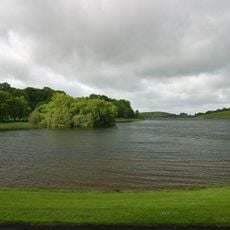
The circle stands in a grassy field 300 m west of Lough Gur, reached from the R512 (Limerick–Kilmallock road) about 4 km north of Bruff. The main circle is fenced off for protection, so the stones are viewed from the outside. The ground is uneven and often wet, so wear sturdy footwear.
On 17 August 2022 the archaeological photographer Ken Williams found previously unrecorded carvings on one of the stones, using raking light to photograph the weathered surfaces. Visitors also leave coins and crystals at the circle, and druids gather here at the summer solstice.
The community of curious travelers
AroundUs brings together thousands of curated places, local tips, and hidden gems, enriched daily by 92,767 contributors worldwide.