Quin Abbey, Franciscan monastery ruins in County Clare, Ireland
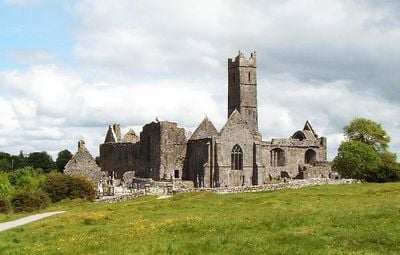
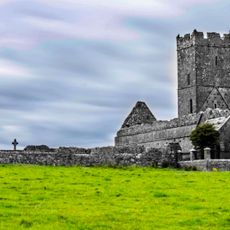
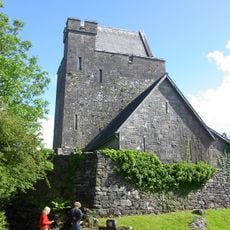
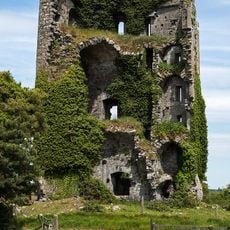
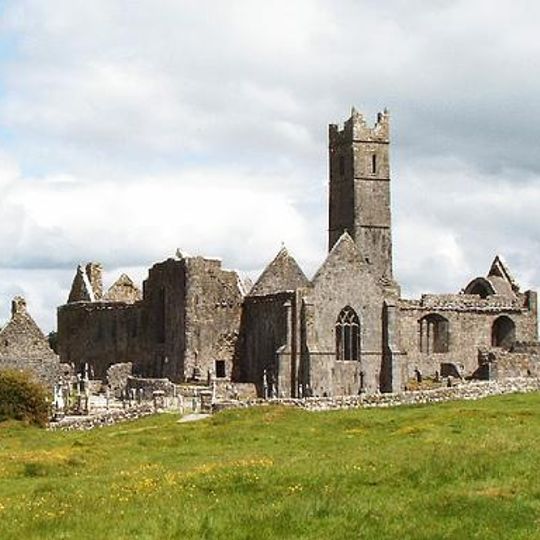
Quin Abbey is a roofless Franciscan friary in Quin, County Clare, built of rough grey stone blocks. A tall square tower with a crenellated parapet and narrow slit windows rises on the right; to its left stands a gabled wall with a large pointed-arch window divided by stone mullions. Lower walls and small triangular gables extend outward, and an intact cloister survives within.
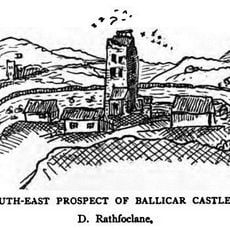
A monastery burned on this site in 1278, and Thomas de Clare then built a Norman castle whose corner-tower foundations remain. Around 1350 the MacNamaras rebuilt the ruined castle as a church, and the present friary was founded between 1402 and 1433, with a papal bull of 1433 approving it. Henry VIII confiscated it in 1541; Cromwell's forces killed the friars and destroyed the friary around 1650, and it was restored in 1671 but never regained its former status.
The name Quin comes from the Irish Cuinche, probably from a tree used to make jam, either the arbutus or the quince. The friary was never an abbey, though locals call it Quin Abbey. The graveyard around the ruins is still in use, and the key to the locked gate can be borrowed in the village.
The site is open year-round with free access to wander among the ruins without formal restrictions. Wear sturdy footwear since paths between the stone remains are uneven and the ground varies in stability.
The site blends architectural elements from three distinct historical periods within a single structure: a 13th-century castle foundation, a 14th-century church addition, and the 15th-century Franciscan monastery. This layered history makes it possible to trace architectural development across nearly 300 years at one location.
The community of curious travelers
AroundUs brings together thousands of curated places, local tips, and hidden gems, enriched daily by 94,059 contributors worldwide.