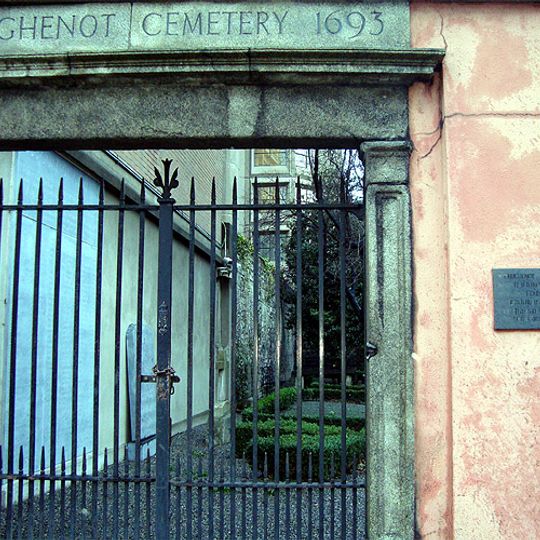
Huguenot cemetery, Dublin, Historic cemetery near St Stephen's Green, Dublin, Ireland.
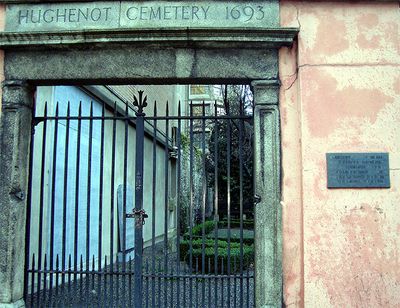
The Huguenot Cemetery is a small walled burial ground on the north side of Merrion Row, a short street linking St Stephen's Green with Upper Merrion Street and Ely Place. It is not open to visitors; a wall plaque to the left of the entrance lists 239 surnames of those buried inside, among them Becquett, relatives of Samuel Beckett, and Du Bédat.
The cemetery dates from 1693, when it was opened for Huguenot refugees who left France after the revocation of the Edict of Nantes. James Butler, 1st Duke of Ormonde, encouraged them to settle in Ireland, hoping their skills in textiles, watchmaking and finance would aid the Irish economy. The last burial took place in 1901.
The cemetery takes its name from the Huguenots, French Protestants who left France after the revocation of the Edict of Nantes. Encouraged to Ireland by James Butler, 1st Duke of Ormonde, they became part of Dublin's commercial life through textiles, watchmaking and finance. Families such as La Touche, Le Fanu and D'Olier are among the 239 surnames inscribed on the wall plaque.
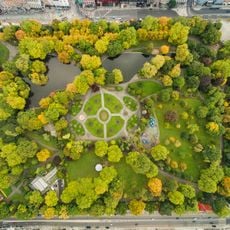
The cemetery is not open to visitors, but the grounds and headstones are clearly visible through the iron gate from the pavement. A short stop here fits naturally into a walk around St Stephen's Green.
A wall plaque to the left of the enclosure lists 239 surnames of those buried here, among them Becquett, relatives of the writer Samuel Beckett, and Du Bédat. The Irish poet Eavan Boland wrote a poem titled "The Huguenot Graveyard at the Heart of the City" about this site.
The community of curious travelers
AroundUs brings together thousands of curated places, local tips, and hidden gems, enriched daily by 93,674 contributors worldwide.