Tyrone House, Georgian manor ruins in Kilcolgan, Ireland
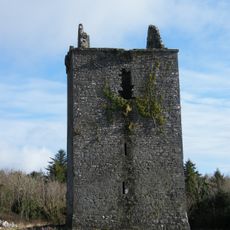
Tyrone House is a roofless Georgian ruin of a three-storey house with a basement, built of limestone on a promontory by the Kilcolgan river estuary in County Galway. Its symmetrical facade has a slightly projecting central bay, a platband, quoins and block-and-start window surrounds. The interior is stripped bare, though the positions of the wine cellar and kitchen can still be traced.
Tyrone House was built by 1779 for Christopher St George, a member of an old Norman Galway family, probably to designs by Waterford architect John Roberts. Violet Martin found it dilapidated in 1912, and Edith Somerville used it as a model for her 1925 novel The Big House at Inver. In 1920 the local IRA burned it, fearing the Black and Tans would use it as an infirmary; a bed-bound caretaker was carried out first. The Irish Georgian Society acquired the ruin in 1972.
The ruined manor is said to have inspired Edith Somerville, an Irish writer of the early 20th century, when she described decaying country houses in her novels. Places like this one carried a strong meaning in Irish society, representing a landlord class that had largely disappeared.
The ruin stands on a narrow road, the L8563, about 3 km west of Kilcolgan and just south of Dunbulacun Bay. The building may not be entered, so the visit is limited to viewing the exterior and the surrounding grounds.
Daniel Augustus Beaufort, writing in the 1780s, called the newly built house "large and new but very bleak and too high". The building is attributed to Waterford architect John Roberts, who planned Moore Hall in County Mayo in a similar style. The Irish Georgian Society acquired the ruin in 1972.
The community of curious travelers
AroundUs brings together thousands of curated places, local tips, and hidden gems, enriched daily by 92,755 contributors worldwide.