Aldborough House, Georgian mansion in Dublin, Ireland
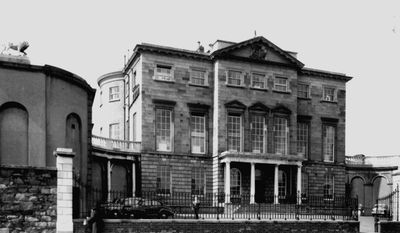
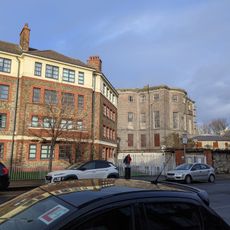
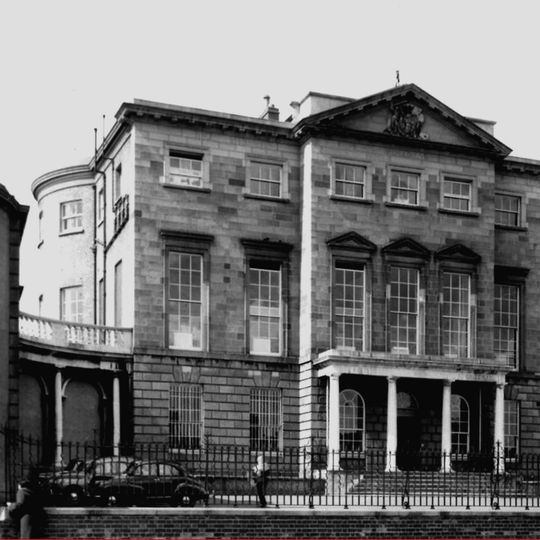
Aldborough House is a tall rectangular Georgian block of three floors over a basement, seven bays wide and three bays deep, on Portland Row. Its north front is faced in granite, while the other elevations are brown brick originally rendered to look like stone. Single-storey bowed quadrants flank the main house, leading to a theatre wing to the east and a now-demolished chapel to the west. Above the portico an inscription reads "Otium cum Dignitate".
Edward Stratford, 2nd Earl of Aldborough, commissioned the house for his second wife Anne Eliza Henniker; foundations were laid in 1792 and the bulk was finished by 1795, though it was still incomplete in 1799 at a cost of over £40,000. After Stratford died in 1801 and his widow in 1802, a court case between her widower and Stratford's nephew John Wingfield left the house empty until 1813. Gregor von Feinaigle then ran a school there until about 1830; the government acquired it in 1843 and used it as a barracks during the Crimean War and Fenian Rising before it became a Post Office depot.
The east wing holds the Lord Amiens Theatre, built between 1792 and 1795 to designs by Edward Stratford himself; campaigners call it the oldest purpose-built theatre in Ireland. Its exterior is unchanged since the 18th century, though the original stage was destroyed in the 1980s. Bram Stoker, who lived next door for a time, is said by some commentators to have drawn settings from the house.
Aldborough House stands on Portland Row, north of Dublin's city centre, and is vacant with no identified new use, so there is no access inside. The exterior can be viewed from the public pavement; the granite north front carries the inscription "Otium cum Dignitate" above the portico. The bowed single-storey wings to either side once led to the theatre and chapel.
The private theatre wing, the Lord Amiens Theatre, was built between 1792 and 1795 to designs by Edward Stratford himself; campaigners call it the oldest purpose-built theatre in Ireland. Its 18th-century stage was destroyed in the 1980s, but the exterior is unchanged. Bram Stoker, who lived next door, is thought by some commentators to have drawn on the house for Dracula settings.
The community of curious travelers
AroundUs brings together thousands of curated places, local tips, and hidden gems, enriched daily by 94,067 contributors worldwide.