Dromiskin Monastery, Medieval monastery and national monument in Dromiskin, Ireland.
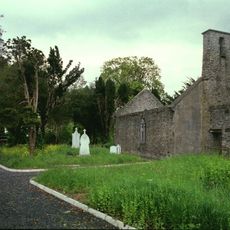
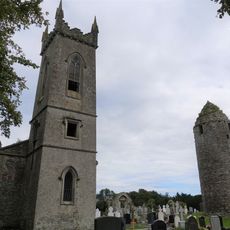
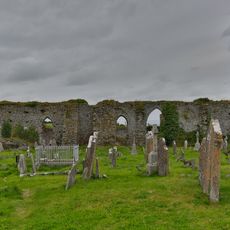
Dromiskin Monastery stands in the centre of Dromiskin village and consists of a round tower, the arms of a high cross on a 1918 shaft, and the gable and foundation of a 12th-century church with a 15th-century window. The tower is 15.25 m tall with a conical cap and a two-order Romanesque doorway 3.7 m above ground.
Dromiskin Monastery was founded in the 6th century by Lugaid, a follower of Saint Patrick, or in the 7th century by Rónán, son of Bearach, who died of the yellow plague in 664. The round tower was built in the 9th century. The monastery was burned by Vikings in 833, plundered in 908, 978 and 1043, and pillaged by Domnall ua Néill in 970. It remained active until the 12th century.
The high cross displays carved scenes from the life of David, showing how religious stories were told in stone at this place. Visitors can still see how these visual narratives mattered to the people who worshipped here.
The monastery stands in the centre of Dromiskin village, not in open fields, so the tower, cross and church gable are reached on foot within the village. The round tower doorway is 3.7 m above ground and cannot be entered from the ground. Ground around the monuments is uneven; sturdy shoes help.
The Uí Chrítáin served as hereditary clergy at Dromiskin, an office passed down within one family rather than appointed by a bishop. The monastery was nonetheless plundered repeatedly: by the Irish in 908, by Vikings in 978 and by the Irish again in 1043, and Domnall ua Néill pillaged it in 970.
The community of curious travelers
AroundUs brings together thousands of curated places, local tips, and hidden gems, enriched daily by 94,026 contributors worldwide.